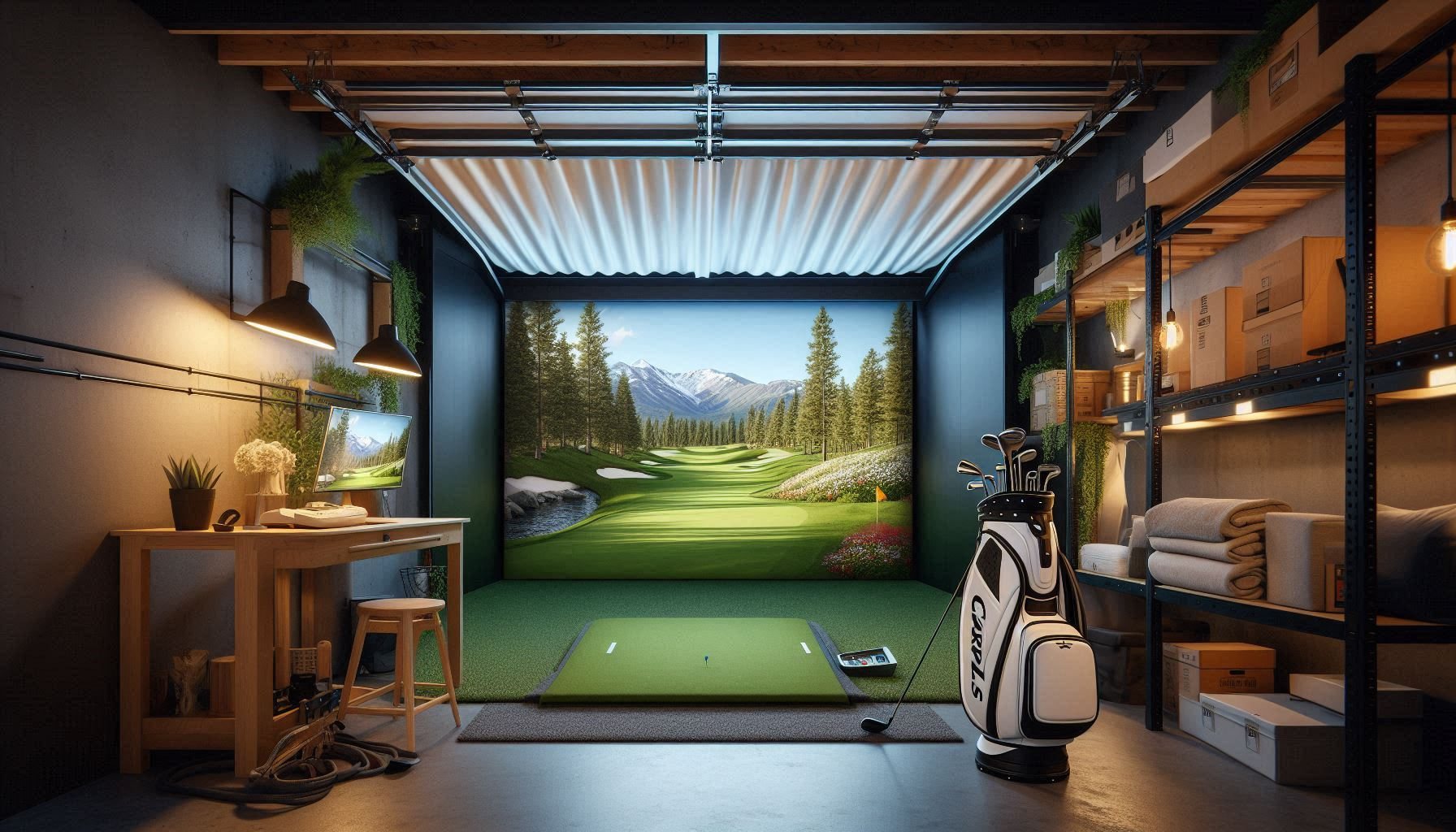
When building a high-fidelity home simulator, the launch monitor tracking hardware often captures all the attention. However, choosing the best impact screens for a garage setup is arguably the most critical structural and safety decision you will make. A poorly engineered screen results in dangerous ball bounce-back, massive acoustic disruption, and a distorted, sagging projected image that completely breaks the virtual illusion.
This specifications audit pits the industry-standard premium enclosure kits from Carl’s Place against a classic home DIY steel pipe assembly. By evaluating raw material tolerances, kinetic energy dampening, and projection fidelity, we determine the exact right framework for your residential space.
Key Takeaways
- Tension Engineering: Carl’s Place utilizes a specialized sliding bungee matrix to achieve a flat, projector-ready surface. DIY setups frequently suffer from localized sagging and screen warping.
- Acoustic Dampening: Premium multi-layer vertical weaves absorb impact shock quietly. Basic canvas sheets create a sharp, high-decibel “crack” that can easily disrupt a household.
- Safety Thresholds: Turnkey enclosures use built-in memory foam cushion boundaries to eliminate hazardous metal frame rebounds.
- The Verdict: Deploy Carl’s Place for an immediate, commercial-grade safety profile. Build a custom EMT conduit frame only if you require a highly irregular, non-standard dimensional layout under a strict £500 limit.
Why Choosing the Best Impact Screens for a Garage Setup Matters
You are firing a solid urethane projectile at over 150 miles per hour inside a tight residential footprint. The screen fabric you choose to absorb that massive kinetic energy must perform three distinct functions simultaneously: it must safely stop the ball without material tearing, it must minimize the trampoline effect (bounce-back), and it must serve as a color-accurate canvas for a short-throw projector.
If your launch monitor data is flawless—such as the precision captured when running high-end software—but your screen looks like a wrinkled bedsheet, your immersive experience is gone.
Decibel Control in Residential Enclosures
Garages are natural acoustic echo chambers. Concrete floors and bare drywall panels amplify sound waves aggressively. When a golf ball strikes a raw, single-layer canvas drop cloth, the noise can be deafening. Premium impact screens are engineered using three-dimensional spacer meshes—essentially a dense foam layer sandwiched between the projection face and a heavy backing layer to muffle the strike.
Image Aspect Ratio Alignment
A standard garage footprint is almost always wider than it is tall. To fill your entire wall space with a projected image without casting ugly black horizontal bars across your view, you need a screen cut to a precise 16:9 or 16:10 aspect ratio. Trying to manually cut, hem, and punch grommets into raw fabric rolls to hit these exact HD coordinates is a highly error-prone task.
The Premium Standard: Carl’s Place Enclosures
Carl’s Place operates as a premium distributor on networks like ShareASale, engineering turnkey enclosure packages that completely remove structural guesswork from a home build.
The Standard DIY and Pro Kits
Despite being labeled a “DIY Kit,” these are highly engineered packages. Carl’s Place provides the custom-hemmed screen fabric, the heavy-duty black nylon enclosure shell, and the engineered steel corner connector joints. To optimize shipping costs, you simply purchase standard 1-inch EMT (Electrical Metallic Tubing) conduit pipes from a local hardware supplier to complete the frame skeleton.
Built-In Safety Advantages
- Zero-Gap Protection: The heavy-duty black enclosure fabric hooks tightly into the screen edge, creating an unbroken safety tent that catches erratic wedges and high-speed shanks before they touch your garage drywall.
- Ricochet Mitigation: The premium kits include form-fitting foam cushions that line the inside perimeter, completely shielding the rigid steel conduit pipes from direct ball strikes.
- Flawless Visual Flatness: By distributing tension evenly via industrial ball bungees, the screen surface remains completely smooth, maximizing your projector’s display resolution.
The Budget Alternative: Free-Standing DIY Pipe Builds
If your capital is heavily concentrated in your launch monitor system, fabricating a frame from raw materials can serve as an alternative.
Sourcing the Framework
The standard DIY framework involves purchasing 1-inch or 1.5-inch EMT steel conduit from a local electrical supply shop. By plotting out a basic rectangular cube and connecting the pipes with heavy-duty structural canopy clamps, a freestanding frame can be erected for under £150.
Sourcing the Textile Screen
This is where home DIY projects frequently encounter serious friction. Many builders attempt to use white canvas tarps or common archival drapery. While these materials will stop a golf ball temporarily, they lack the tensile strength to survive repeated driver strikes and tear rapidly. If you build a custom frame, you must still purchase an un-hemmed piece of authentic, multi-layer impact fabric to ensure long-term durability.
Final Audit Verdict
When selecting the best impact screens for a garage setup, your decision must map strictly to your room depth and capital availability:
- IF Your Budget Allows for Turnkey Safety Construction: Deploy a Carl’s Place Enclosure Kit. The integrated safety canopy and memory-foam ricochet dampeners offer an unassailable protection profile for home properties.
- IF Your Garage Requires a Custom Footprint Under £500: Construct a Freestanding EMT Conduit Frame, but do not compromise on the textile layer. Settle for raw, industrial-grade impact fabric rather than standard hardware store tarps.