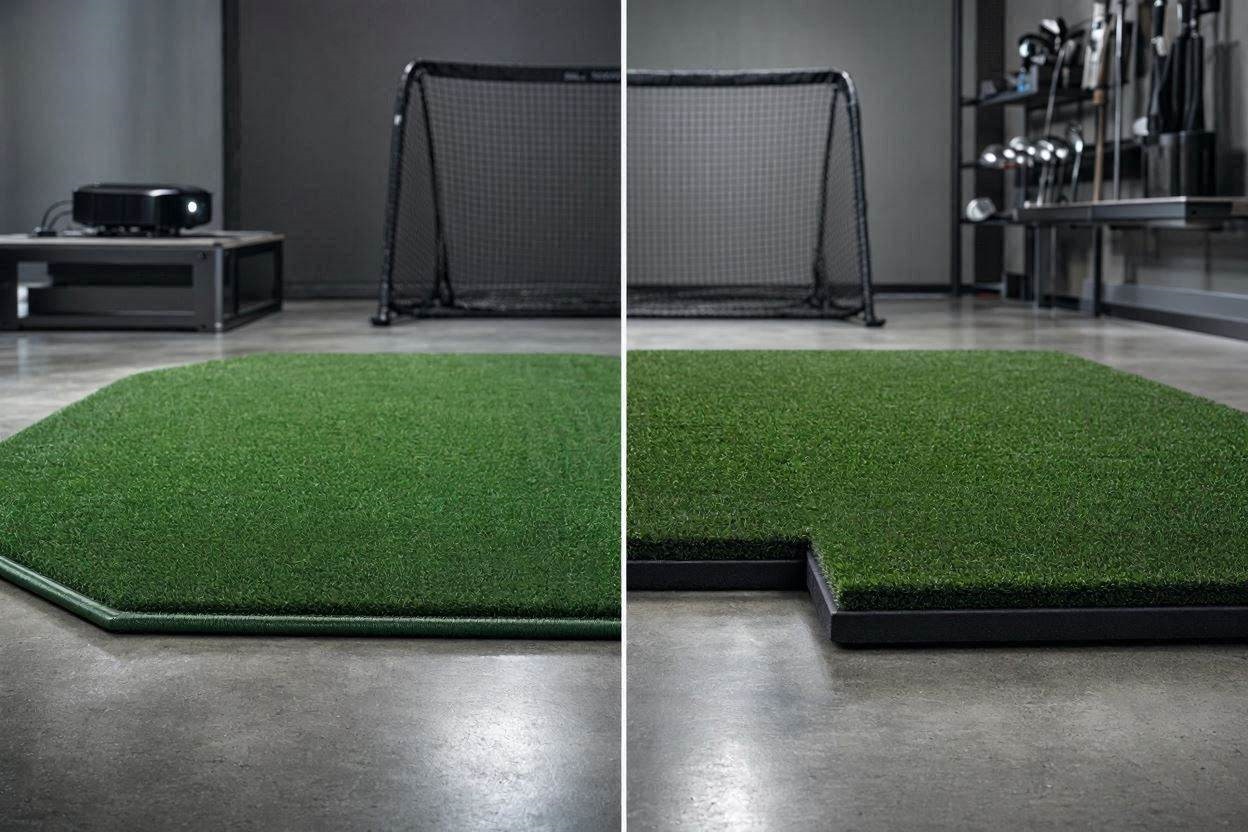
When constructing your first indoor hitting bay, prioritizing your capital on high-end launch monitors and projection screens is a natural impulse. However, skimping on the physical surface beneath your feet is the most common and physically destructive error new builders make. Finding the best budget golf simulator mats requires navigating a minefield of cheap, thin plastics that will shatter your wrists and warp your launch monitor data. In 2026, the two heavyweights dominating the entry-level conversation are the GoSports Elite 5×5 (often found for around $149-$165) and the legendary Real Feel Country Club Elite (CCE) 5×3 configuration exclusively sized for big-box retailers like Costco.
If you are currently debating whether a 5×3 footprint is too narrow for a driver swing, or if a cheaper 5×5 mat will survive daily iron practice without causing severe golfer’s elbow, you are at a critical crossroads. This comprehensive, highly technical engineering guide will break down the exact foam densities, spatial dimension constraints, and shock-dissipation capabilities of these two surfaces to help you identify the ultimate foundation for your garage setup.
The “Quick Answer” / Key Takeaways
- The Spatial Constraint: A 5×3 mat is exceptionally narrow. When hitting a driver, taller players will find their heels resting precariously on the back edge of the concrete, making the 5×5 GoSports Elite a safer choice for stance stability.
- The Density Delta: The Country Club Elite utilizes a massive 110-ounce per square yard nylon fiber density, which accurately grabs the clubhead during a fat shot. The GoSports Elite uses a lighter polypropylene turf that is more prone to artificial clubhead skipping.
- Thickness Matters: The CCE boasts a total assembly thickness of 1-3/4 inches, providing superior shock absorption over concrete compared to the 1.25-inch total thickness of the GoSports Elite.
- The Hybrid Solution: The ultimate budget hack is purchasing the larger 5×5 GoSports Elite for stance comfort, and eventually cutting a rectangular slot into it to drop in a premium, specialized hitting strip if joint pain develops.
1. Defining the Best Budget Golf Simulator Mats: Dimensions vs. Quality
The initial friction point when evaluating the best budget golf simulator mats is the stark trade-off between physical footprint and raw material quality. When you have a strict budget of under $250, you are mathematically forced to sacrifice either the width of your stance area or the thickness of the shock-absorbing foam base.
The 5×3 Spatial Conundrum (Country Club Elite)
Costco’s offering of the Real Feel Country Club Elite (CCE) at the 5-foot by 3-foot dimension presents a massive quality-to-size dilemma. The CCE is universally recognized as commercial-grade material. However, 3 feet of depth is remarkably shallow for a modern golf swing.
When you set up for a driver, you must place the golf ball close to the front edge of the mat so your launch monitor can properly track the flight. If the ball is placed 6 inches from the front edge, you only have 30 inches of mat remaining behind the ball to accommodate your stance. A standard adult male features a shoulder-width stance of approximately 18 to 22 inches. When you flare your feet out for a driver swing, your back heel will hover dangerously close to the concrete floor. This creates severe psychological hesitation; the fear of stepping backward off a 1-3/4-inch ledge mid-swing completely ruins your kinetic sequencing. The 5×3 CCE is an incredible hitting strip, but as a full stance mat, it operates at the absolute minimum threshold of physical safety.
The 5×5 Stance Advantage (GoSports Elite)
Conversely, the GoSports Elite provides a sprawling 5-foot by 5-foot (or octagonal) hitting area. This massive 25-square-foot footprint completely eliminates stance anxiety. You can position the ball anywhere, flare your feet for a driver, or narrow your stance for a delicate 60-degree wedge without ever feeling the edge of the mat. Furthermore, the octagonal shape of some GoSports models allows you to seamlessly rotate the mat 45 degrees every few weeks, distributing the heavy iron impact zones across eight different sections of the turf, vastly extending the mat’s usable lifespan. When prioritizing footprint, the GoSports model easily ranks among the best budget golf simulator mats for pure spatial freedom.
2. Technical Specification Breakdown: Hitting Surface Physics
To accurately benchmark the best budget golf simulator mats, we must dissect the chemical composition of the synthetic turf canopy. The visual appearance of green plastic is deceptive; the engineering of the yarn dictates how the mat interacts with the leading edge of a forged iron traveling at 90 miles per hour.
GoSports Elite 15mm Turf Architecture
The GoSports Elite utilizes a commercial-grade polypropylene (PP) synthetic turf. Polypropylene is highly durable and naturally resistant to moisture, making it ideal if your garage setup doubles as a partially open outdoor bay facing a driveway. The 15mm (0.59-inch) elite turf layer is designed to be tightly woven and relatively firm.
Because PP fibers possess a lower melting point and a slightly slicker surface tension than raw nylon, the clubhead tends to glide or skid across the top of the canopy. This is a double-edged sword. It minimizes rotational torque on your wrists if you hit it slightly fat, but it also creates a less realistic interaction compared to actual organic grass.
Country Club Elite 110 oz. Nylon Density
The Country Club Elite completely abandons polypropylene in favor of a proprietary Long Dense Fiber System comprised of premium nylon. Nylon is significantly more robust, features a higher melting point (preventing green plastic residue from melting onto the sole of your irons), and creates immense physical friction.
The CCE boasts a total yarn weight of 110 ounces per square yard, manufactured on a 1/4-inch machine gauge. This staggering density is the core reason the CCE is revered. The fibers are packed so tightly that they perfectly simulate the physical drag of real soil. When you strike a pristine iron shot—hitting the ball first, then the turf—the nylon yields gracefully. But if your attack angle is steep and you hit 2 inches behind the ball, the 110-ounce nylon matrix aggressively grabs the clubhead, rapidly decelerating the shaft. This “True Divot Action” provides hyper-realistic feedback, ensuring you cannot cheat the simulator with poor ball-striking mechanics.
[IMAGE PLACEHOLDER: A split-screen illustration showcasing how a golf club face glides over polypropylene turf versus digging into dense nylon turf + Alt Text: Comparing turf drag physics on the best budget golf simulator mats]
3. The Biomechanics of Budget Mats: Joint Protection Analysis
The most critical factor in choosing the best budget golf simulator mats is evaluating their biomechanical safety. Practicing indoors means you are repeatedly striking a rigid concrete subfloor. Without proper kinetic energy dissipation, the shockwaves travel instantly up the steel shaft into your carpal and elbow tendons, causing severe medial epicondylitis (golfer’s elbow).
Shock Absorption and Foam Sublayers
The GoSports Elite utilizes a 15mm (approx. 5/8-inch) EVA foam backing. While EVA foam is excellent for lightweight padding, its cellular structure is prone to rapid plastic deformation under heavy, high-velocity strikes. When you hit down on the GoSports mat, the EVA foam compresses, but it has a lower elastic return threshold. The total assembly thickness of the GoSports Elite is 1.25 inches.
The Country Club Elite is engineered with a heavy-duty 5/8-inch closed-cell foam secondary backing. Closed-cell foam is significantly denser and more resilient than standard EVA. When combined with the massive 1-inch thick nylon canopy, the total assembly thickness reaches 1-3/4 inches (1.75″). This extra half-inch of highly engineered material provides a substantially larger deceleration zone for the clubhead. The kinetic energy of your swing is absorbed and dispersed laterally across the heavy 7-ounce primary backing before it ever reaches the concrete, offering vastly superior joint protection for high-volume practice sessions.
Fat Shot Penalties and “Mat Bounce”
One of the most frustrating anomalies associated with the best budget golf simulator mats is “mat bounce.” When you hit a cheap, thin mat with a steep angle of attack, the clubhead cannot penetrate the hard rubber backing. Instead, the sole of the iron violently bounces off the sublayer, skipping upward into the equator of the golf ball.
This creates a dangerous data illusion. On a real grass fairway, that fat shot would travel 40 yards and stop. On a thin budget mat, the club bounces into the ball, generating massive artificial ball speed and a perfectly straight launch angle on your simulator screen. The dense 110-ounce nylon of the Country Club Elite completely eliminates mat bounce by trapping the clubhead before it can rebound. The GoSports Elite, with its firmer PP fibers and slightly thinner profile, will exhibit a minor degree of bounce on severe mis-hits, meaning you must be vigilant about analyzing your smash factor data to detect artificial strikes.
[EXTERNAL LINK: Detailed biomechanical study analyzing shock transfer and flexor tendon strain caused by rigid artificial golf mats]
4. Why the Best Budget Golf Simulator Mats Must Handle Wooden Tees
A frequently overlooked requirement when searching for the best budget golf simulator mats is how the surface accommodates driver practice. Cheap mats force you to use pre-cut rubber tubes (Tee holes) inserted through the bottom of the foam.
The GoSports Elite features 6 to 12 pre-cut holes and includes 3 standard rubber tees. While functional, rubber tubes are notorious for grabbing the clubface at impact, slightly twisting the driver head and altering your spin axis data. Furthermore, rubber tees have fixed heights; if you prefer a lower tee height for a 3-wood, you are forced to physically cut the rubber tube with a razor blade.
The Country Club Elite is celebrated precisely because its Long Dense Fiber System is thick and rigid enough to hold a standard wooden tee. You literally take a real wooden or plastic tee and shove it directly into the nylon fibers anywhere on the mat, exactly as you would on a real tee box. The 110-ounce density clamps the tee upright. This provides total freedom to adjust your tee height instantly for different clubs, and it ensures zero rubber-tube interference with your clubface during impact. This feature alone drastically elevates the CCE within the hierarchy of the best budget golf simulator mats.
5. The Affiliate / Monetization Section: When to Upgrade Your Hitting Strip
Eventually, even the best budget golf simulator mats will experience concentrated wear. Because you are hitting from the exact same square foot of space in your garage to maintain launch monitor alignment, the central strike zone will eventually compress and lose its shock-absorbing qualities. When this happens, you do not need to throw away the entire 5×5 mat. You can perform the ultimate hybrid upgrade.
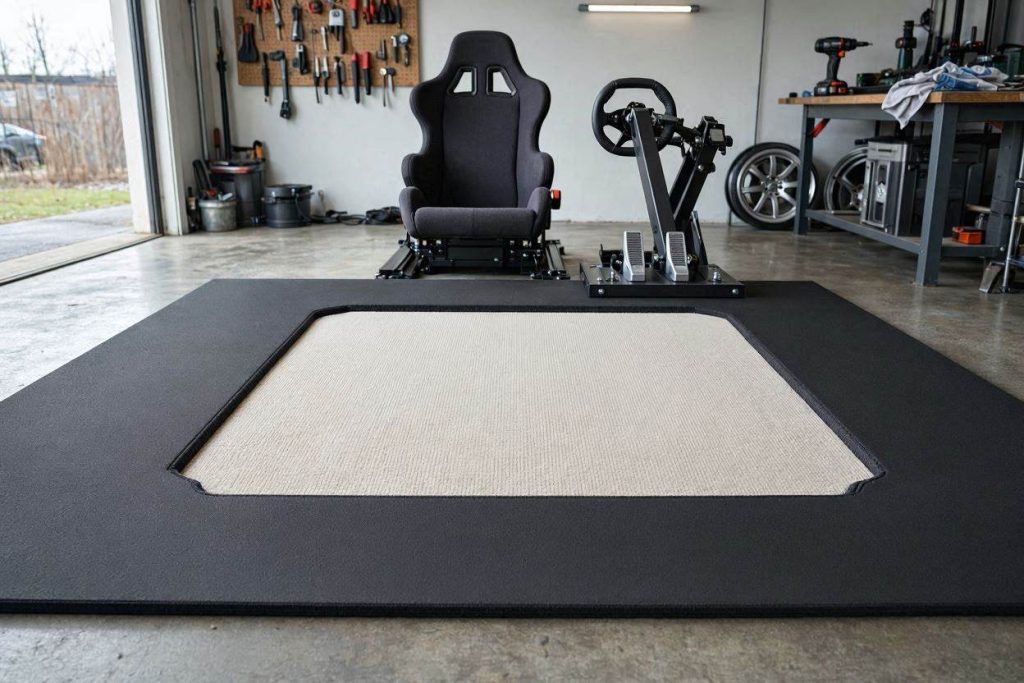
If you purchase the larger GoSports Elite 5×5 for its superior stance coverage, you can easily convert it into a commercial-grade setup. Using a heavy-duty utility knife, cut a 12-inch by 28-inch rectangular slot directly into the center hitting zone of the GoSports mat.
Once the slot is cleared, you can insert a premium, highly engineered hitting strip into the void. We highly recommend upgrading to the Sigpro Softy Hitting Strip or the Fiberbuilt Grass Series Insert. The Sigpro Softy utilizes a specialized compression-slot matrix that virtually eliminates elbow pain, while the Fiberbuilt utilizes low-friction bristles with a 300,000-shot guarantee.
By sourcing these premium inserts through authorized specialized dealers like The Indoor Golf Shop or Carl’s Place (accessible via elite affiliate networks like ShareASale or PartnerStack), you guarantee you are receiving authentic, warrantied technology. This hybrid approach gives you the massive 5×5 stance footprint of the GoSports budget mat paired with the elite, injury-preventing strike physics of a $1,000 commercial system, all for a fraction of the cost.
6. Launch Monitor Tracking Compatibility and Alignment Offsets
When you install any of the best budget golf simulator mats, you must manually reconcile the physical height of the mat with the optical tracking requirements of your launch monitor. This is a critical step that dictates the accuracy of your entire simulator.
Photometric Camera Systems and Turf Height Offsets
If you are using a camera-based system like a SkyTrak+, Bushnell Launch Pro, or Uneekor Eye Mini, the monitor sits parallel to the hitting zone. These optical systems are calibrated to expect the golf ball to sit on a perfectly flush, level horizon line.
If you choose the Country Club Elite, the ball is resting 1-3/4 inches above the concrete floor. If you place your launch monitor directly on the concrete beside the mat, the cameras are looking up at the ball. This severe vertical offset will completely distort your launch angle calculations, causing the software to read an artificially high trajectory and erratic spin axis numbers. You must build a rigid wooden or polymer spacer block to elevate your launch monitor so its base is perfectly level with the top of the turf canopy.
Radar Interference Profiles
If you are running a Doppler radar system positioned behind the golfer (like the Garmin Approach R10 or FlightScope Mevo+), the mat thickness is less problematic, but the material composition is critical. Both the GoSports Elite and the CCE are entirely free of heavy metals or reflective metallic sublayers, making them fully transparent to microwave radar signals. However, because the CCE eliminates “mat bounce,” it allows the radar to track the true, organic deceleration of your clubhead through the turf, providing vastly superior smash factor analytics compared to the skidding effect generated by thinner, harder PP mats.
Ultimate Guide to Calibrating the Uneekor Eye Mini for Indoor Mat Accuracy
7. Maximizing Your Investment: Custom Setup Hack and Maintenance
To extract the maximum lifespan from the best budget golf simulator mats, you must engineer a flawless floor integration. If you simply throw a 5×5 GoSports Elite or a 5×3 CCE onto a slick, dusty garage floor, the massive kinetic torque of a 110mph driver swing will cause the mat to slide and twist. A sliding mat ruins your target alignment and causes severe foot slipping that leads to knee and hip injuries.
The Anti-Slip Subfloor Trick
Do not rely on the stock foam backing to grip raw concrete. To lock your mat down permanently without using messy glues, utilize the Carpet Tape and Gym Tile Hack.
- Purchase a pack of 1/2-inch thick, cheap EVA puzzle-piece gym floor tiles from any hardware store.
- Assemble the tiles to match the exact 5×5 or 5×3 footprint of your golf mat.
- Apply double-sided, heavy-duty fiberglass carpet tape around the absolute perimeter of the gym tiles, and press your golf mat firmly onto the tape.
The soft EVA gym tiles naturally grip the porous concrete of the garage perfectly, preventing all lateral sliding. Furthermore, adding this 1/2-inch layer of sub-foam beneath your budget golf mat acts as a secondary shock absorber, dramatically improving the joint-protection qualities of both the GoSports Elite and the CCE.
Preventative Maintenance Quick-Action Checklist:
- Rotate the Impact Zone: If you own a square or octagonal mat, physically rotate the mat 90 degrees every 4 weeks to prevent the foam cells from permanently collapsing in one specific impact zone.
- Vacuum the Nylon Matrix: Static electricity from indoor swings acts as a magnet for dust and sand. Vacuum the turf fibers weekly; embedded sand acts like sandpaper, rapidly shredding the synthetic yarn during iron impacts.
- Monitor Humidity: If your garage is unheated, freezing winter temperatures will cause the foam backing to become brittle. Always use a space heater to bring the ambient room temperature to at least 60°F before swinging, ensuring the foam regains its elasticity to properly absorb shock.