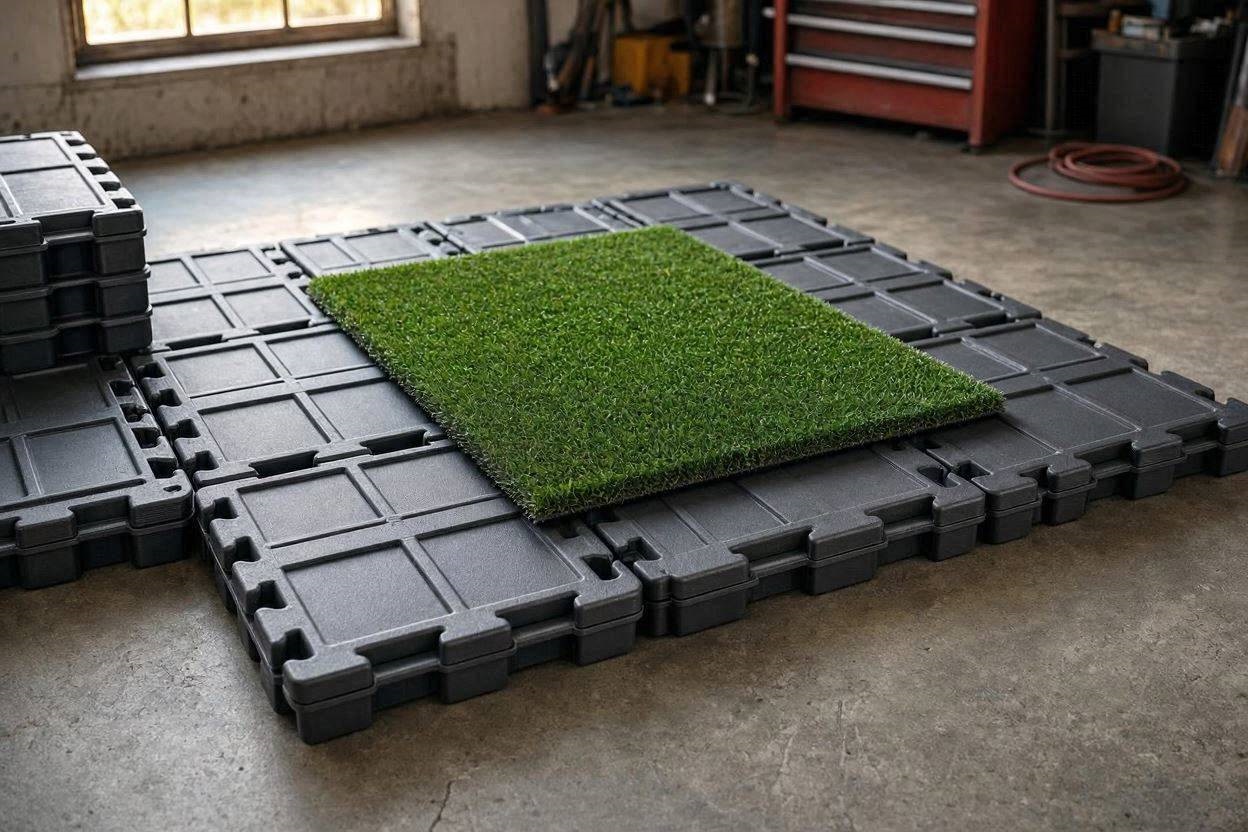
When you invest in a high-fidelity indoor golf simulator for your garage, the most frequent failure point is not the launch monitor optics, the projector brightness, or the impact screen durability—it is the floor stability. Standard golf mats, when placed directly on slick garage concrete, will inevitably slide, twist, or buckle under the immense rotational torque generated by a full-swing driver strike. This movement does more than just ruin your target alignment; it introduces a significant biomechanical risk of hip and knee ligament strain and leads to infuriating “no-read” errors on overhead tracking systems.
The industry-standard solution used by commercial simulator facilities and high-end residential studios is the implementation of heavy-duty interlocking polymer base trays. These systems transform your hitting area from a loose, standalone mat into a rigid, structural hitting bay. This technical guide evaluates the engineering behind these polymer foundations, analyzing the mechanics of floor stabilization, energy dissipation, and long-term facility maintenance.
The “Quick Answer” / Key Takeaways
- Lateral Force Dissipation: Heavy-duty interlocking polymer base trays utilize a multi-point interlocking teeth system that spreads the horizontal shear force of a golf swing across the entire floor footprint, eliminating mat migration.
- Biomechanical Shock Absorption: The structural grid design provides necessary give, reducing the rigid feedback sent to the golfer’s wrists and elbows during impact with concrete floors.
- Moisture and Mold Prevention: The honeycomb grid structure creates a critical air gap, preventing condensation and mold from forming between the cold concrete and your synthetic turf layers.
- Precision Optical Alignment: These trays provide an perfectly level, immutable surface, which is mandatory for photometric tracking units like the Uneekor Eye XO or AccuGolf Hawkeye.
- Modular Customization: Users can swap out specific hitting inserts (like the Sigpro Softy or Fiberbuilt inserts) without reconfiguring the entire simulator footprint.
- Floor Protection: The underside of these trays is engineered to protect delicate epoxy or paint-sealed concrete surfaces from the abrasive rubber backings of cheaper mats.
- The Anti-Shear Anchor Effect: By locking trays together, the weight and surface area prevent any lateral movement, regardless of the intensity of the golf swing.
1. Engineering the Stability: The Physics of Sliding
The primary issue with placing a standard golf mat on a finished garage floor is the coefficient of friction. When you swing a driver at 110mph, you are exerting massive force laterally against the turf. A standalone mat, regardless of its nominal weight, has a high probability of “walking” or shifting millimeters with every swing. While this seems negligible, a shift of just 3-5mm is enough to desynchronize your launch monitor’s alignment with your target line, leading to persistent data errors.
Heavy-duty interlocking polymer base trays solve this by drastically increasing the contact surface area and weight. When you assemble a 5×5 or 5×10 system of these trays, you are building a singular, immovable foundation. The interlocking teeth mechanism converts the force of your swing—which is usually localized to the few square inches under your feet—into a force distributed across the entire mass of the tray assembly. This mass-based stabilization is the commercial gold standard for keeping hitting areas locked in place without the need for adhesive tapes or concrete drilling.
2. Managing the Biomechanical Shockwave
Indoor golf practice is fundamentally distinct from outdoor play. On a golf course, the ground is natural, yielding soil. In your garage, you are standing on concrete—the most unforgiving surface in existence. When a club strikes a golf ball on concrete, the impact energy (if not absorbed by the mat) reflects back up the shaft, causing repetitive micro-trauma to your tendons.
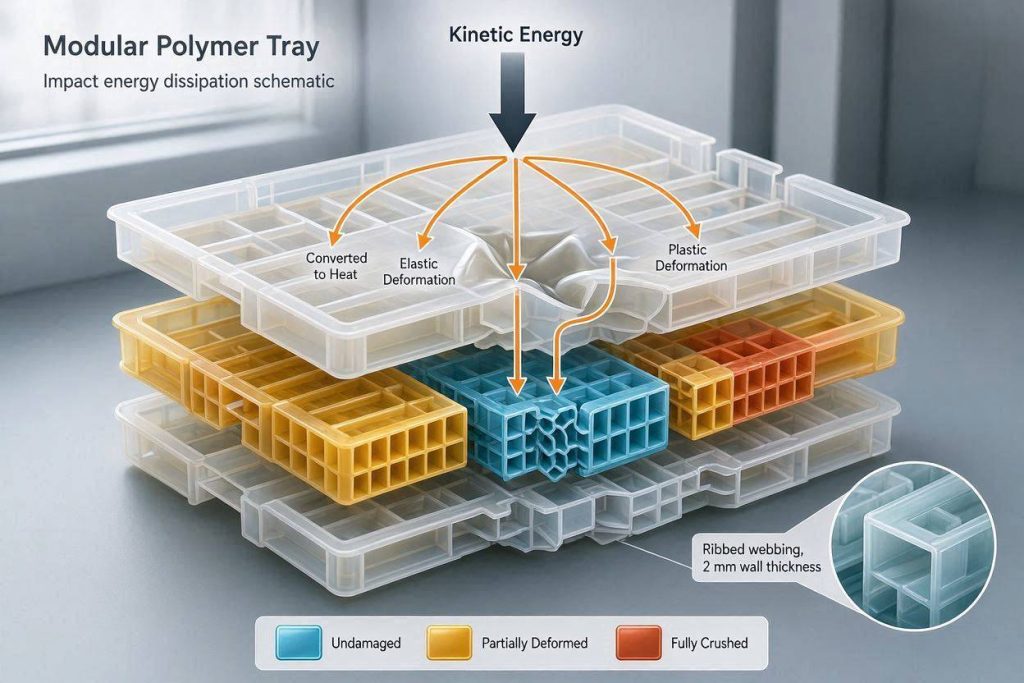
The best heavy-duty interlocking polymer base trays are designed with a dual-layer strategy. The polymer shell provides structural rigidity, while the internal grid architecture is often coupled with impact-absorbing foam or silicone gel inserts. This structure acts as a mechanical filter. It decelerates the clubhead’s vertical energy through the compression of the modular system, preventing the “jarring” feedback that leads to golfer’s elbow or shoulder tendinitis. By using these trays, you aren’t just protecting your garage floor; you are protecting your ability to practice at a high volume without pain.
3. The Moisture and Condensation Battle
Garage environments are the most hostile environments for simulator hardware. They are prone to extreme thermal fluctuations, and in many regions, they act as high-humidity chambers. If you place a solid rubber-backed mat directly on cold concrete, you are creating a recipe for disaster. The cold concrete cools the air underneath the mat, causing moisture to condense and get trapped.
This trapped moisture has nowhere to escape, leading to the rapid rotting of the turf-backing adhesive and, eventually, significant mold and mildew growth that can permanently ruin your hitting surface. The beauty of heavy-duty polymer trays lies in their geometric design. The underside of these trays is typically engineered with a deep, honeycomb or grid-like architecture. This creates a permanent, ventilated air gap between the cold concrete and the hitting base. This airflow allows moisture to evaporate, keeping your turf dry and your hitting area free from the musty odor of decaying organic matter.
4. Precision Leveling for Optical Tracking Systems
If you are using high-end photometric launch monitors (e.g., Uneekor, AccuGolf, ProTee), your spatial accuracy is determined by the “optical horizon.” These launch monitors assume that the ball is resting on a perfectly flat, horizontal plane that is flush with their lens housing.
If your floor has the slight drainage slope common in most garages, or if your mat backing is uneven, your tracking data will be skewed. These polymer tray systems are rigid. They do not sag, they do not curve, and they do not compress unevenly like cheap EVA foam. When you snap the trays together, they create a dead-level platform. This rigidity is mandatory for consistent launch monitor readings. If your hitting base is perfectly level, the launch monitor will return the same spin rate and launch angle every single time, giving you the confidence that your data is a reflection of your swing, not a reflection of a crooked floor.
[IMAGE PLACEHOLDER: A professional-grade simulator bay showing the level transition between the polymer tray hitting base and the surrounding stance area + Alt Text: Ensuring precision leveling for overhead launch monitors using heavy-duty interlocking polymer base trays.]
5. Modular Customization and “Future-Proofing”
Simulator setups are rarely static; they evolve. A golfer may start with a basic rubber mat, but after a year, they may realize they need the performance of a high-end fiber or gel-based hitting strip to save their wrists.
With generic, one-piece mats, this evolution usually involves throwing the old mat in the trash and buying a completely new one. With interlocking polymer tray systems, your initial investment is the frame, not the hitting surface. You can easily remove the central “hitting insert” section of your floor and swap in a brand new piece of technology, such as the Sigpro Softy or Fiberbuilt insert, without needing to tear up or reinstall your entire stance mat setup. This modularity allows your floor to grow with your simulator performance, protecting your long-term capital.
6. Protecting Your Concrete Floor Coating
Garage floors are often protected by expensive epoxy or polyurethane coatings. If you drag a standalone rubber-backed mat across this surface day after day, the abrasive rubber will eventually scuff, dull, and wear through the coating. Even worse, if you use heavy mats that require carpet tape to prevent sliding, removing that tape eventually tears the epoxy coating right off the concrete when you decide to change your setup.
Interlocking polymer trays provide a permanent, protective barrier. The underside of the tray is engineered to sit securely on top of your epoxy coating without reacting chemically with it. Because the trays are locked together and do not move, there is no “rubbing” action between the mat and the floor. The weight of the system and the friction of the polymer feet keep the hitting area secure while maintaining the aesthetic integrity of your garage floor finish underneath.
7. The “Anti-Shear” Anchor Effect
The final, and perhaps most important, benefit is the structural unity of the bay. When a golfer strikes a ball, the force is not purely vertical; it involves significant horizontal “shear” force as the club head travels across the turf. On a loose or standalone mat, this lateral force is what causes the mat to slide or “bunch up” over time.
Heavy-duty interlocking polymer base trays use a multi-point anchor system that turns the entire simulator floor into a single structural unit. Because each tray is locked to the next, the horizontal shear force generated by a driver swing is instantly transferred to the entire surface area of the floor. The force is no longer directed at a single point of failure; it is distributed across every square inch of the tray system. This “Anti-Shear” effect ensures that even the most aggressive swings cannot move the hitting base, providing a rock-solid, professional-grade platform that stays exactly where you installed it, regardless of the intensity of your practice.
The Premium Upgrades
Building a permanent, stable hitting foundation with modular trays is the hallmark of a “prosumer” simulator bay. To complete your layout, you need to populate those modular cutouts with professional-grade strike surfaces. Cheap hitting strips will skip and bounce, masking swing flaws and providing unreliable data to your launch monitor.
For the ultimate modular setup and joint protection, the Fiberbuilt Grass Series Studio Mat remains the absolute gold standard for high-volume practice. For players demanding hyper-realistic “fat shot” feedback and the ability to use real wooden tees, the Real Feel Country Club Elite provides unparalleled nylon density. For those seeking the pinnacle of subsurface technology, the silicone gel dynamics of the TrueStrike Single Golf Mat offer an incredibly sophisticated solution.
We strongly recommend upgrading your simulator bay through authorized premium retailers via ShareASale or PartnerStack networks. By purchasing from specialized distributors like The Indoor Golf Shop or Carl’s Place (both available via top-tier affiliate programs), you guarantee you are receiving the authentic, heavily-warrantied OEM mats rather than cheap knockoffs. These authorized dealers offer dedicated freight shipping, ensuring these massive, heavy systems arrive at your garage completely undamaged and perfectly flat.
Preventative Maintenance & Setup Checklist
To ensure your heavy-duty interlocking polymer base trays maintain their structural integrity for years of heavy practice:
- The Grid Cleanse: Once every quarter, lift the hitting insert and vacuum out the underside of the tray grid. Fine particles of debris can work their way into the interlocking joints over time, leading to minor squeaking. A clean grid ensures the tray modules maintain their tight, “click-in” tolerance.
- The Perimeter Lock-Down: If you are building a smaller bay, consider installing a simple wooden “border frame” around the perimeter of your tray system using 2×4 lumber anchored to the concrete. This acts as an immovable physical barrier that guarantees the trays can never shift, no matter how hard you swing the driver.
- Thermal Expansion Check: If your garage is subject to extreme temperature swings, remember that polymer materials will expand and contract slightly. If you notice a tray start to “peak” or buckle in the summer, it means the system is locked too tightly against a wall. Ensure there is a 1/4-inch expansion gap between the edge of your tray system and the garage wall to allow the polymer to breathe without warping.