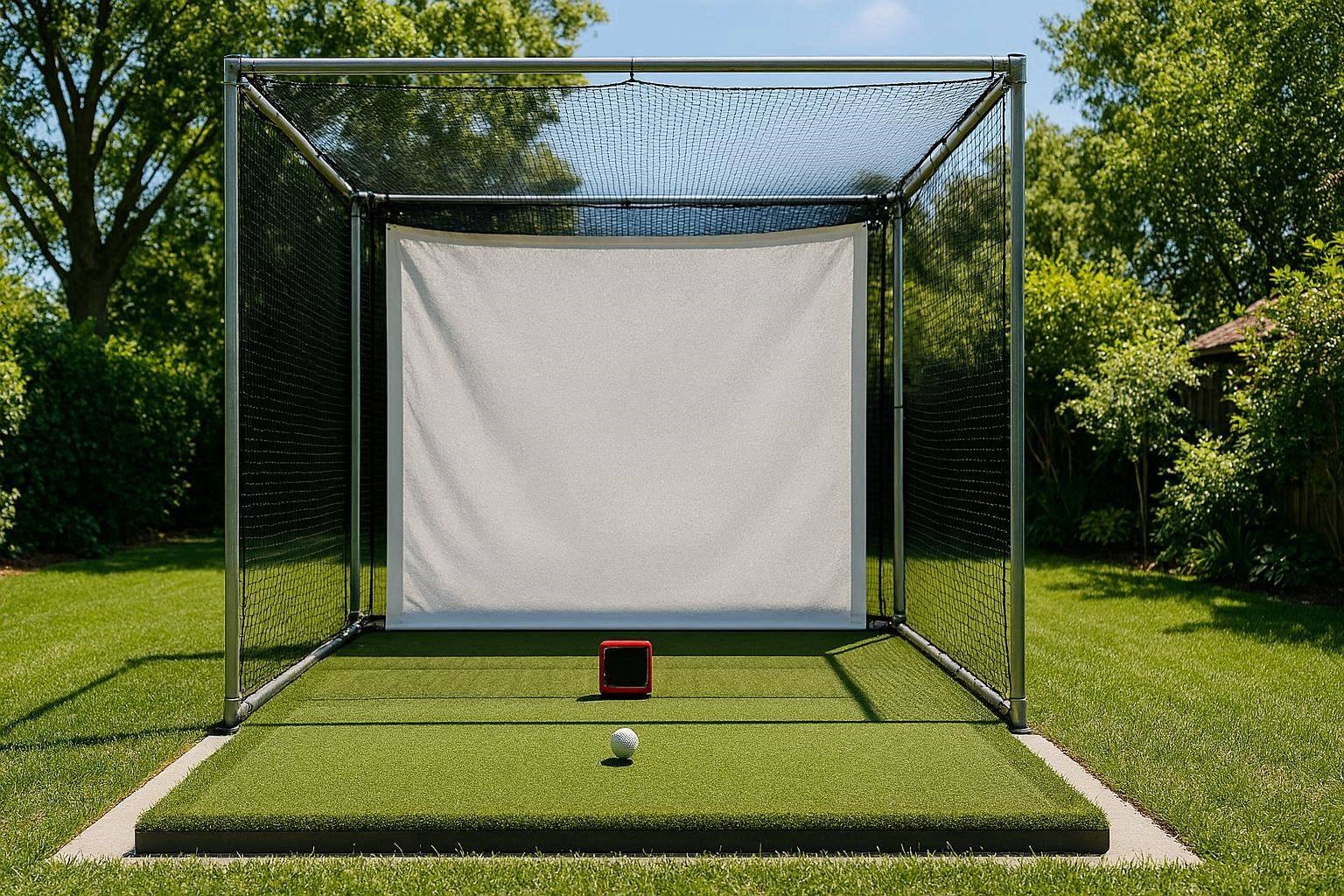
Constructing a reliable Mevo outdoor net setup is far more complex than just popping up a generic sports net in your backyard. When dealing with precision 3D Doppler radar systems like the FlightScope Mevo Gen2 or Mevo+, the spatial geometry, hardware rigidity, and surface leveling must be absolutely flawless.
If your radar is misaligned by a single degree, or if your enclosure frame shifts in the wind, your data will be entirely compromised. Many golfers mistakenly believe that any 10x10x10 cage will work right out of the box, only to encounter severe sagging, tracking failures, and structural collapses.
This guide breaks down the precise mechanical and spatial requirements to execute a flawless Mevo outdoor net setup. We will cover exact depth formulas, radar-to-mat leveling protocols, and how to build a storm-proof hitting platform that guarantees maximum accuracy.
The “Quick Answer” / Key Takeaways Box
- Space Requirements: A proper Mevo outdoor net setup requires 8 feet of space behind the ball for radar placement and 8 to 13 feet of ball flight in front.
- Frame Rigidity: Flimsy retail cages often snap in bad weather; upgrade to 1-inch EMT conduit from a local hardware store using heavy-duty steel corner brackets.
- Net Sag Compensation: A standard 10x10x10 net sags heavily upon impact. Golfers must position their tee closer to the front opening to avoid catching the net on a driver follow-through.
- Leveling Protocols: The Mevo must sit perfectly level with the hitting mat; there cannot be a depression or “dip” between the radar and the ball.
- Spin Accuracy: For limited flight setups, Titleist RCT balls or metallic aluminum stickers are strictly required for accurate spin rate readings.
Decoding the Doppler Radar Spatial Geometry
The most critical factor in your Mevo outdoor net setup is managing the required physical footprint. The Mevo relies on continuous wave Doppler radar to track the ball after it leaves the clubface.
Unlike camera-based systems that capture a snapshot exactly at impact, radar must “watch” the ball travel through the air to calculate apex, spin, and axis data. This means a compact footprint is mechanically impossible.
The 25-Foot Envelope Rule
A standard 10x10x10 cage feels large, but it barely accommodates the necessary radar envelope. The FlightScope unit must be positioned 8 feet directly behind the golf ball to measure accurately.
From the tee, the absolute minimum distance to the net or impact screen is 8 feet, but FlightScope officially recommends 13 feet for the most precise spin and shot shape readings. When you add the required 8 feet behind the ball, the hitting zone, and the ball flight, you need a minimum total depth of 16 to 21 feet.
If you are using a 10x10x10 cage, you cannot stand entirely inside the back of the net. To achieve the necessary 12 to 14 feet of ball flight, your hitting mat must be placed 2 to 3 feet outside the front of the cage. Therefore, your total required operating length expands to roughly 25 feet.
Preventing Signal Interference
Doppler radar emits microwave frequencies that bounce off the moving golf ball. However, they also bounce off other objects. In a Mevo outdoor net setup, you must eliminate localized interference.
Ensure there are no rotating fans, active air conditioning units, or fluorescent lights within the radar’s field of view. Even thick metallic poles holding up your net can cause minor signal scattering if placed too close to the tracking corridor.
Fixing the 10x10x10 Net Sag Dilemma
One of the most common physical failures in a Mevo outdoor net setup involves the netting itself. High-velocity golf balls carry immense kinetic energy. When a ball traveling at 160mph strikes a loosely hung net, the material stretches violently.
This stretching phenomenon is known as “net sag.” If you are not careful, this sag can lead to catastrophic hardware damage or personal injury.
The Follow-Through Hazard
When building a 10x10x10 enclosure, players often try to stand deep inside the cage for maximum safety. However, standard nets sag inward. A golfer who is over 6 feet tall and standing on a 3-inch thick hitting mat can easily catch the net on their driver follow-through.
If the club head tangles in the nylon mesh at maximum speed, it can snap the shaft or pull the entire cage down. To prevent this, you must hit with the ball positioned right at the front edge of the cage, or slightly behind it.
Bungee Tensioning and Baffle Screens
To mitigate net sag, you cannot simply pull the side panels completely taut. A net that is too tight will cause the golf ball to violently bounce back at the player.
Instead, use heavy-duty bungee cords to anchor the bottom corners of the net, allowing a slight amount of slack to absorb the kinetic energy. Additionally, hanging a secondary archery baffle screen or premium impact screen 12 inches in front of the main net will vastly reduce the stretch distance and protect the primary netting from wearing out prematurely.
[IMAGE PLACEHOLDER: Close up shot of heavy duty bungee cords attaching a thick golf net to metal conduit piping + Alt Text: Securing a Mevo outdoor net setup using tensioning bungees]
Upgrading to an EMT Conduit Frame
Most consumer-grade 10x10x10 net kits purchased online feature thin fiberglass or cheap aluminum poles. These frames are notoriously flimsy and will often collapse or snap during a heavy storm.
For a permanent or semi-permanent Mevo outdoor net setup, you must discard the factory poles and build a custom rigid frame.
The Home Depot Hardware Hack
The industry standard for DIY golf simulator cages is 1-inch Electrical Metallic Tubing (EMT). EMT conduit is cheap, incredibly strong, and highly resistant to wind sheer.
You can purchase 10-foot lengths of EMT conduit from any major hardware store. To connect the piping, you must order specialized steel corner brackets (often referred to as 3-way or 4-way canopy fittings).
Slide the EMT pipes into the steel corners and lock them down with the integrated set screws. This creates a rock-solid, galvanized steel 10x10x10 cube that will easily support heavy impact screens, side shank nets, and intense weather conditions without flexing.
Anchoring the Structure
Because EMT conduit frames are heavy, they can act like a giant sail when the wind catches the netting. It is imperative that you anchor the four base corners.
Use heavy steel ground augers or heavy-duty sandbags to pin the base poles to the earth. A shifting frame will alter your target line and ruin the alignment of your Mevo outdoor net setup.
Engineering the Hitting Platform
A critical, yet often ignored, component of a Mevo outdoor net setup is the ground below the ball. You cannot simply throw a hitting mat onto a patchy lawn and expect accurate radar data.
The FlightScope Mevo requires an absolutely flat, level surface to calculate launch angles correctly. Furthermore, there are strict rules regarding the elevation between the radar and the hitting zone.
The “No Dip” Rule
The Mevo can physically sit slightly lower than the hitting mat, but there cannot be a depression, valley, or “dip” between the radar unit and the mat. If the radar signal has to travel through a physical trough or if the terrain is uneven, the microwave frequencies will scatter, resulting in dropped shots or wildly inaccurate spin numbers.
To ensure perfect line-of-sight, you must build a continuous, flat platform that houses both the radar and the golfer.
Constructing the Wood Base
If your backyard is sloped, you must build a custom leveling platform. The most effective method is to construct a frame using treated 2×4 lumber.
Install heavy-duty adjustable leveling feet at the corners of the 2×4 frame to compensate for the slope of the grass. Once the frame is perfectly level (verified with a long spirit level), sheet the top of the frame with 3/4-inch OSB (Oriented Strand Board) or exterior-grade plywood.
Turf Integration
Bare wood is loud and visually unappealing. Wrap the entire OSB platform in cheap, outdoor weather-resistant artificial turf. Use heavy-duty staples to secure the turf tightly around the edges.
Finally, staple or glue your premium, 3-inch thick soft hitting mat directly into the center of the platform. Create a dedicated, level spot directly 8 feet behind the hitting zone where the Mevo will sit permanently. This ensures the unit never moves and is always perfectly aligned with the target line.
[EXTERNAL LINK: Learn more about structural lumber load limits for outdoor decks here.]
Mastering Radar Calibration and Environment Settings
Once the hardware of your Mevo outdoor net setup is locked in, you must calibrate the software to match your physical environment. The Mevo Gen2 and Mevo+ are highly sensitive instruments that require exact inputs to function.
The Mevo Gen2 weighs just 1.1 lbs and has dimensions of 6.9 x 1.2 x 5.6 inches, making it incredibly portable but highly dependent on software configurations.
Setting the Proper Mode
Within the FS Golf App, you must select the correct tracking mode. Because you are hitting into a net, you are operating in “Limited Flight” mode, not “Outdoor Full Swing” mode.
Limited flight mode tells the algorithm to calculate the full trajectory based on the first 8 to 13 feet of ball flight. If you accidentally leave the device in Full Swing mode while hitting into a net, it will constantly search for a descending ball that never happens, resulting in extreme errors.
The Importance of Spin Measurement
Doppler radar calculates carry distance based primarily on ball speed, launch angle, and spin rate. In a limited flight setup, the radar only has a fraction of a second to measure the spin of the ball.
To guarantee accurate spin data in a Mevo outdoor net setup, you must use Titleist RCT (Radar Capture Technology) golf balls, or apply the included aluminum metallic stickers to standard balls. These metallic markers provide a massive, highly reflective signature for the radar to lock onto, allowing it to accurately count the revolutions per minute before the ball hits the net.
[INTERNAL LINK: Check out our complete guide to fixing dropped shots on radar launch monitors.]
High-Quality Upgrades for Flawless Data
If you are serious about extracting every ounce of accuracy from your Mevo outdoor net setup, DIY solutions will only take you so far. To achieve commercial-grade simulation, you must upgrade your netting and mat infrastructure. Flimsy Amazon nets and hard, joint-destroying mats will ultimately bottleneck the capabilities of your FlightScope radar.
By routing your upgrades through premium, specialized retailers, you guarantee longevity and precision.
Upgrade 1: The SimSpace Enclosure System
Instead of hacking together EMT conduit and bungee cords, the ultimate permanent fix is investing in a professional-grade SimSpace enclosure. Available through specialized golf retailers on networks like PartnerStack or Impact, these enclosures are engineered specifically for high-speed radar setups.
They feature blackout side panels that prevent ambient light interference and heavy-duty, multi-layer impact screens that absorb kinetic energy without violent bounce-back. A premium enclosure ensures your 13 feet of ball flight is perfectly encapsulated and safe.
Upgrade 2: The Fiberbuilt Grass Series Mat
A cheap mat placed on OSB plywood will eventually cause severe elbow and wrist pain due to the shock of fat shots. The permanent upgrade for your Mevo outdoor net setup is a Fiberbuilt Grass Series hitting mat.
Fiberbuilt mats use a proprietary bristle technology that perfectly simulates the turf interaction of real fairways while completely absorbing the impact of the clubhead. Because the Mevo tracks Angle of Attack and Club Path, an accurate turf interaction is mandatory for realistic swing data. You can source these through premium affiliate partners outside of standard consumer marketplaces.
Upgrade 3: Titleist Pro V1 RCT Golf Balls
Do not waste time meticulously applying aluminum stickers to cheap range balls. The Titleist Pro V1 RCT balls are engineered with an embedded radar-reflective core.
These balls are specifically optimized for indoor and limited-flight radar environments. They instantly solve spin-axis misreads and ensure your Mevo captures a pristine Doppler signature on every single shot, allowing you to dial in your driver numbers with absolute confidence.
Preventative Maintenance and Quick-Action Checklist
A Mevo outdoor net setup requires ongoing maintenance to ensure it survives the elements and continues to deliver Tour-level accuracy. Ensure you protect the radar unit from direct moisture, as it is not fully waterproof.
Always follow this quick-action checklist before every session:
- Use a spirit level to verify the platform has not settled or shifted in the dirt.
- Confirm the Mevo is positioned exactly 8 feet behind the tee.
- Check the EMT corner brackets and tighten any loose set screws.
- Inspect the primary netting or baffle screen for micro-tears before hitting high-speed driver shots.
- Ensure the FS Golf App is set to Limited Flight mode and device battery is adequately charged.