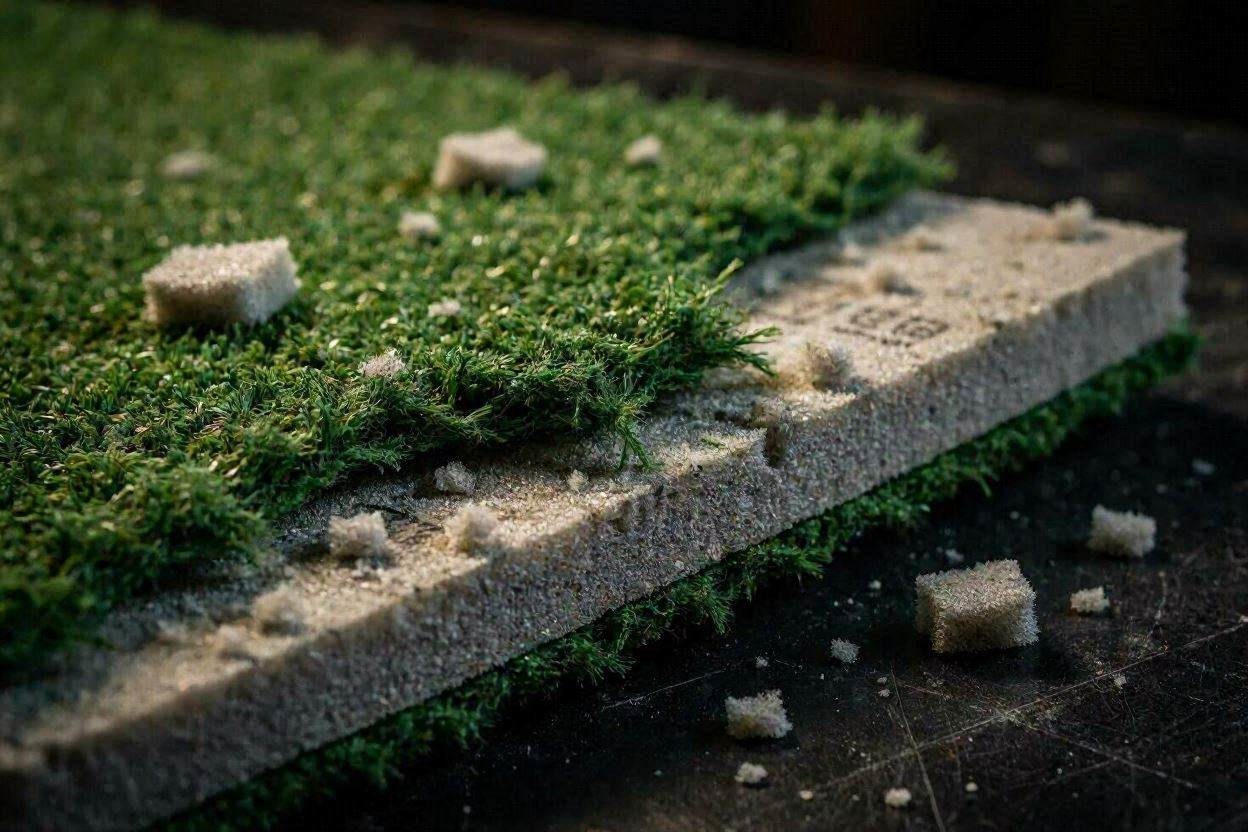
If you are currently building out your indoor golf sanctuary, the surface you choose to stand on is the most critical engineering decision in the entire process. While the temptation to save capital by purchasing budget-grade, mass-market EVA foam golf mats is strong, doing so introduces a cascade of physical and technical failure points that will compromise your simulator investment. In 2026, the data is unequivocal: cheap polymer-backed mats are not just a poor practice surface; they are a biomechanical liability.
This technical guide breaks down the chemical composition, shock-absorption coefficients, and data-degrading nature of standard EVA (Ethylene-Vinyl Acetate) foam backings. If you are serious about long-term simulator health and data precision, understanding why these materials fail is the first step toward building a tour-level environment.
The “Quick Answer” / Key Takeaways
- Hysteresis Failure: Cheap EVA foam golf mats lack the necessary elastic return (hysteresis) to absorb the kinetic energy of an iron strike, forcing that energy directly into your carpal and elbow tendons.
- Data Distortion: Low-density foam allows the clubhead to “bounce” during a fat strike, creating an artificial sensation of clean contact that renders your launch monitor’s feedback completely useless.
- The Delamination Trap: EVA foam degrades rapidly under high-frequency impact cycles. The chemical bonding between the turf and the foam layer will harden and crack within 500-1,000 swings, leaving you with a slick, dangerous surface.
- The Permanent Upgrade: Transitioning to heavy-duty, high-density hitting strips with silicone gel or high-density fiber backings is the only reliable way to maintain both joint health and data accuracy.
1. The Material Science of EVA Foam Failure
To understand why standard EVA foam golf mats fail, we must look at the polymer science of the material itself. EVA, or Ethylene-Vinyl Acetate, is a copolymer designed for low-cost, lightweight applications—think pool noodles, flip-flops, or kid’s play mats. It is not an engineering-grade impact polymer designed for the high-velocity, high-mass strike of a steel or graphite golf club.
In manufacturing, EVA foam is produced via a chemical blowing agent that creates millions of tiny air-filled cells within the polymer matrix. When you strike down on these cells, they compress. In a high-quality rubberized or silicone-gel backing, the material is engineered with a high degree of “viscoelasticity,” meaning it deforms to accept the force and then rapidly returns to its original shape.
EVA foam backings, by contrast, possess poor “memory.” After just a few hundred strikes, the air bubbles inside the foam structure begin to rupture or permanently collapse (a process known as plastic deformation). Once these internal cells collapse, the mat loses its ability to dissipate shock. You are effectively left standing on a thin layer of hardened plastic that rests directly on your concrete subfloor. The mat is no longer an absorber; it becomes an extension of the floor.
2. The Biomechanics of “Mat Bounce” and Joint Degradation
The most immediate and dangerous consequence of hitting off cheap EVA foam golf mats is the physical trauma inflicted on the golfer. When a golfer strikes the ball with a steep angle of attack, the clubhead must penetrate the surface. On real grass, the turf shears away, creating a divot and allowing the club to decelerate safely.
On a cheap, hardened EVA mat, the clubhead strikes an immovable object. Because the mat has lost its shock-absorption properties, the entire force of the swing—often exceeding 800 to 1,000 pounds of instantaneous pressure—is redirected back up the club shaft. This creates a vertical shockwave that travels through the hands and into the sensitive ligaments of the wrist and elbow.
This is the primary driver of “Golfer’s Elbow” (medial epicondylitis). The tendons are subjected to high-frequency, high-amplitude vibrations that they are not biomechanically designed to withstand. If you find your elbows aching after a 30-minute practice session on your simulator, it is almost certainly because the kinetic energy is not being dissipated by your mat.
Furthermore, the lack of give in the mat creates a phenomenon known as “mat bounce.” When you hit slightly behind the ball, a real grass fairway would grab the clubhead, slowing it down and resulting in a “chunked” shot. On a hardened EVA mat, the sole of the club hits the mat, bounces off the rigid foam, and skips upward into the ball’s center. The launch monitor registers a decent-looking shot, giving you instant, positive feedback on a fundamentally flawed swing mechanic. You aren’t just hurting your joints; you are actively learning to hit the ball fat.
3. Data Distortion: How Low-Density Foam Ruins Launch Monitor Accuracy
If you have invested in a high-end launch monitor, the quality of your mat is directly correlated to the quality of your analytics. Photometric (camera-based) and radar-based launch monitors are designed to track the clubhead through a very specific spatial window.
When you strike a cheap mat, you are changing the physical geometry of the hitting zone. Because the EVA foam has likely developed a “divot” or a compression zone from previous swings, the ball is rarely sitting at the exact height the launch monitor expects. If the ball sits 3-5mm lower than intended because the mat has deformed, the launch monitor will capture the clubface interacting with the ball at a skewed angle.
This results in “ghost” data:
- Launch Angle Errors: The system calculates a vertical launch angle based on an incorrect impact height.
- Spin Rate Inflation: The clubhead may be picking up stray particles of the deteriorating foam backing, causing the cameras to misread the spin axis.
- Inconsistent Carry Distances: The “bounce” effect causes higher ball speeds than a genuine strike would produce, giving you inflated confidence that doesn’t hold up on a real course.
[IMAGE PLACEHOLDER: A side-view technical diagram of a clubhead skipping off a rigid foam mat vs. penetrating a high-density, professional-grade hitting strip + Alt Text: Comparing clubhead interaction on EVA foam golf mats versus professional hitting strips for launch monitor accuracy.]
4. The Delamination Trap: Why Cheap Mats Turn into Asphalt
The lifecycle of low-cost hitting mats is incredibly short. Manufacturers of generic mats prioritize the “initial feel” over long-term structural integrity. They achieve this soft initial feel by using a lightweight, fluffy synthetic grass layer bonded to the EVA foam base using low-grade, heat-sensitive adhesives.
Within a few months of regular use, the intense frictional heat generated by club impact begins to break down these adhesives. The turf layer starts to separate from the foam, a process called delamination. Once delamination begins, the turf “bunches” when you take your stance. This creates a wrinkled, uneven surface.
Stepping onto a bunched, delaminated mat is like standing on an unstable, slick carpet. It completely ruins your ability to maintain a consistent swing plane. You become more focused on balancing your weight on the uneven surface than on your swing rotation. This instability is a direct cause of hip and lower-back pain, as your body micro-adjusts in ways that are totally unnatural for a standard golf swing.
5. Benchmarking the Alternatives: What to Use Instead
Once you have identified the structural flaws in EVA foam golf mats, you need to transition to professional-grade hardware. The golf simulation industry has pivoted toward two specific types of backings that provide the necessary energy dissipation and structural rigidity required for high-volume practice.
The High-Density Fiber Architecture (e.g., Fiberbuilt)
Premium mats like the Fiberbuilt Grass Series utilize long, vertical, low-friction synthetic bristles. These bristles are specifically engineered to stand upright, allowing the clubhead to pass through them without the “grab” or “bounce” associated with traditional carpeted mats. The foundation is a heavy-duty, interlocking rubberized grid that sits flat on the subfloor and provides massive energy dissipation across the entire frame. These systems are designed to last for hundreds of thousands of strikes without hardening or delaminating.
The Silicone Gel Subsurface (e.g., TrueStrike)
The gold standard for injury prevention remains the silicone-gel pocket system. In this architecture, a rugged hitting strip surface rests directly above a sealed gel-filled bladder. When you strike the turf, the gel is forced outward, providing a physical proxy for natural soil displacement. The gel absorbs the energy, preventing any shock transfer back to the golfer. This is the only surface that truly simulates the physical sensation of taking a divot, making it the preferred choice for golfers with previous wrist or elbow injuries.
[IMAGE PLACEHOLDER: A macro-cross section comparison of a professional silicone-gel hitting insert versus a standard EVA foam golf mat + Alt Text: Visualizing the difference between professional gel-based hitting strips and cheap EVA foam golf mats.]
6. The Permanent Fix: Investing in Premium Hitting Strips
If you are currently hitting off an EVA foam golf mat, your first and most effective upgrade is to switch to a dedicated hitting insert. You do not need to replace your entire 10-foot by 10-foot flooring footprint. You simply need to replace the 1-foot by 2-foot section where you actually place the ball.
For the ultimate practice environment, we recommend sourcing your replacement inserts through authorized premium golf simulator distributors. Retailers like The Indoor Golf Shop or Carl’s Place (frequently accessible via top-tier affiliate networks like ShareASale or PartnerStack) provide verified, industrial-grade hitting strips that are built for commercial volume.
These premium inserts are designed to sit in a recessed frame within your existing flooring. By replacing your center EVA hitting zone with a professional, high-density nylon mesh or gel-backed strip, you instantly solve the two primary issues: you stop the club from bouncing, and you eliminate the shockwaves traveling up your arm. Investing $300-$500 in a pro-grade hitting insert is significantly cheaper than the medical bills associated with chronic tendonitis.
[EXTERNAL LINK: Technical comparison guide: The best injury-prevention hitting strips for 2026]
7. Preventative Maintenance: The “Turf Rotation” Strategy
Even if you invest in a professional-grade hitting strip, your indoor environment is still a high-wear facility. Indoor golf practice creates “hot spots”—concentrated zones of high wear directly where the player places the ball for every swing.
The Rotation Strategy: If you are using a modular hitting strip (like a 12″ x 28″ insert), rotate the strip 180 degrees every 30 days. This shifts the impact load from the front of the mat to the back of the mat, effectively doubling the usable life of your turf surface.
The Debris Clearance: Static electricity generated by nylon fibers causes dirt, sand, and tiny foam particles to accumulate in the base of the turf canopy. If left uncleaned, this debris acts like sandpaper, rapidly grinding down the nylon fibers and wearing out the turf face in weeks. Keep a shop-vac with a soft brush attachment in your simulator bay and vacuum the hitting area thoroughly at least once per week. This simple step preserves the fiber texture and ensures your photometric launch monitor has a clean, high-contrast surface for every shot.