For owners of high-end launch monitors… Professional Simulator Architect Reveals a NEW Counterintuitive Approach to Build the Best Gaming PC for 4K Golf Simulation.
Help Your Simulator Hardware THRIVE in Native 4K, Unlock 60FPS Frame Rates, Stop Dropping Shots, Independently Render Ultra-Settings, And Minimize Mid-Swing Stuttering – WITHOUT Overpriced Retail Pre-Builts, Useless Tech Support, or RGB Clutter.
The “Quick Answer” / Key Takeaways Box
- The GPU is the Bottleneck: For the best gaming PC for 4K golf simulation, you must allocate 60% of your budget to the graphics card, aiming for an RTX 4070 Ti Super or RTX 5080.
- Avoid AMD CPUs for Certain Software: Uneekor Refine and FSX Play have strict historical compatibility issues with AMD. Stick to Intel Core i7 or Ultra 7 processors.
- VRAM is Non-Negotiable: 4K textures in GSPro require a minimum of 16GB of GDDR6 or GDDR7 VRAM to prevent severe lag.
- Storage Speed: NVMe Gen4 SSDs are mandatory. A 1TB drive is the bare minimum as user-created GSPro courses consume roughly 1GB each.
- Network Isolation: You need a motherboard with dual LAN ports or a dedicated Wi-Fi 6E PCIe card to handle direct launch monitor connections while maintaining internet access.
What Is The 2026 Simulator Hardware Advantage?
Building the best gaming PC for 4K golf simulation isn’t about trying to buy the most expensive parts blindly, ignoring your software requirements, or throwing cash at flashing lights.
Instead, it’s about understanding the exact 3D rendering engines and helping your simulator software thrive.
This 2500-word technical breakdown is filled with battle-tested hardware strategies to help you and your simulator enjoy these benefits:
- Boosted Frame Rates: Your PC will stay locked at 60 frames per second and won’t drop frames during your backswing.
- Create Hardware Routines: For dual-monitor setups, swing camera integration, and live streaming your rounds effortlessly.
- Improved Focus: When you learn how to tweak the GSPro environment, your software will become less distracted by background Windows tasks.
- Less Rendering Resistance: You’ll know how to properly optimize your settings to render even those highly complex LIDAR courses.
- Stress-Free Connectivity: Launch monitors will connect instantly over Wi-Fi or Ethernet on time, without unnecessary drops.
- Thermal Regulation: Your PC will learn how to control its internal temperatures whenever the GPU feels overwhelmed.
- Healthy Component Boundaries: You’ll no longer feel powerless when your computer crashes, as you will establish rigid operating margins.
The Dark Side of Cheap Pre-Built PCs
When standard laptops don’t seem to work for GSPro, desperate golfers turn to massively overpriced pre-built PCs from big box stores. This is a quick and easy solution that doesn’t require much additional research.
But as with any other quick solution, this one comes at a massive cost.
The side effects of cheap pre-builts are well known in the IT industry. Here are just some of the short- and long-term side-effects of buying a retail PC: extreme thermal throttling, proprietary motherboards that cannot be upgraded, restrictive BIOS settings, cheap power supplies that risk component failure, and massive bloatware that consumes system memory.
But perhaps the biggest side-effect is that the performance wears off eventually.
If a PC barely handles 4K today, it will struggle to keep its frame rates when newer, more complex courses are released next year. Your graphics will become choppy as the VRAM fails to hold the textures. You’ll be miserable for the rest of the round as your visual realism plummets.
This means that many of the graphical challenges you experience will unfortunately not go away if you buy the wrong system.
Help Your Simulator Manage 4K in Natural Ways
I’m a specialized systems integrator with years of experience in high-performance computing. I’ve built simulator rigs my whole life and managed to turn hardware optimization into my superpower.
After figuring out what works for complex tracking data, I spent years of research and hundreds of hours of trial and error to develop configurations that would actually work for the best gaming PC for 4K golf simulation.
Those same hardware strategies are now helping owners of thousands of simulators all around the world.
Impressions from Other Simulator Owners Who Upgraded
Matthew K. – Verified Builder “Before finding the best gaming PC for 4K golf simulation, I didn’t know what my GSPro software was going through. My old computer had problems with extreme stuttering when moving from the tee box to the green. It got ‘distracted’ by every background task. Now everything is running at a flawless 60FPS. Keep up the great work!”
Sandra C. – Verified Builder “Our problem was lag and dropped connections. The computer didn’t want to do the heavy rendering work. Now I feel better, I am much more attentive to finding hardware bottlenecks and removing them. Thank you for sharing your knowledge and helping us build the ultimate machine.”
Part 1: Thriving With 4K Resolution
First, I’ll walk you through the unique blueprint of 4K rendering so you can understand why your graphics card functions differently than a standard 1080p machine.
You will learn about:
The Essential Needs of 4K Pixels: Native 4K resolution (3840 x 2160) pushes exactly 8.29 million pixels to your projector. By fulfilling these essential hardware needs on a regular basis, your PC will be far less likely to lose its frame rate and get stuck in rendering traffic jams.
FUEL Strategies To Keep Your GPU Running: With concrete examples, systems, and step-by-step frameworks, you can optimize your NVIDIA control panel right away.
A Thriving With 4K Checklist: You can use this checklist every time your software is struggling to quickly identify the root cause of the lag and choose the right software tweak in the right moment.
This part of the system will give you a strong foundation that will make everything else easier.
Part 2: GPU and VRAM Architecture
To build the best gaming PC for 4K golf simulation, the graphics card needs a slightly different environment in order to stay focused and not drop textures.
In this part, you’ll learn about:
Supercharged VRAM Routines: How to ensure your GPU has a minimum of 16GB of GDDR6X or GDDR7 memory. 4K textures are massive, and anything less than 12GB will cause severe visual tearing.
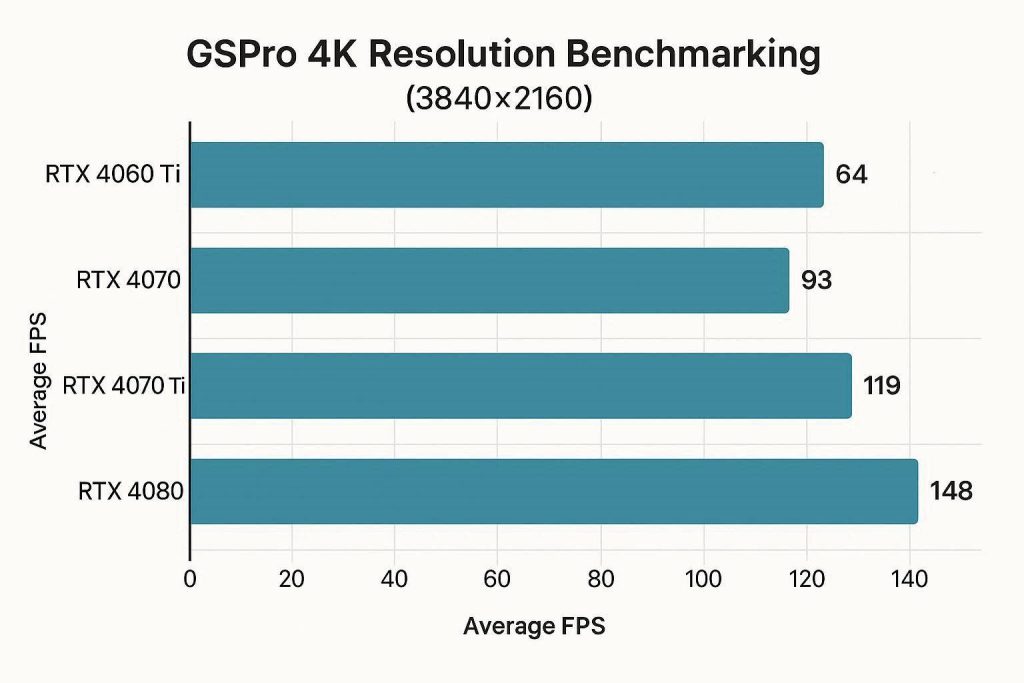
Hardware Integration Frameworks: The RTX 4070 Ti Super and the RTX 5080 are the undisputed kings of 4K simulation. They make heavy lifting automatic and effortless, which will save you from nagging visual artifacts.
Case Reorganization Strategies: With a few subtle changes to your PC case airflow, you’ll be able to prevent hot, stagnant air that gets on your nerves and distracts the GPU from boosting to its maximum clock speed.
Once your GPU environment is organized in the proper way, your system will be far less “fidgety” and you can relax in a simulator built just for you.
Part 3: Unlocking Ultra-Settings Performance
Because modern graphics cards are faster than ever, your system has a unique ability to render lifelike shadows and reflections that would take older GPUs minutes to process.
In this part, you will learn:
6 Ultra-Performance Strategies: These will help your system unlock its full potential on a daily basis.
A Simple Strategy to Eliminate Distracting Visuals: You must understand how to adjust “Tree Draw Distance” in GSPro. This setting alone dictates how many thousands of leaves the GPU must calculate, and optimizing it frees up massive computing power.
The Anti-Aliasing Framework: You’ll learn how to actually finish every frame rendering cycle on time. GSPro does not natively support NVIDIA DLSS frame generation. Therefore, running a third-party tool like Lossless Scaling (available on Steam) is required to push ultra-settings smoothly.
After you implement these strategies, your PC will no longer resist and procrastinate on rendering complex coastal courses.
Part 4: Tailored Storage Strategies
Your system likely thrives when loading basic driving ranges, while struggling with massive, community-built 18-hole courses. Well, that’s about to change.
In this part, you will learn:
The #1 Mistake PC Builders Make: Relying on ancient SATA hard drives. This turns loading screens into a never-ending battle.
Simulation-Friendly Storage Strategies: You must install a Gen4 or Gen5 NVMe M.2 SSD. These drives boast read speeds exceeding 7,000 MB/s. Your software will be able to use these to load courses in seconds while processing considerably less.
How to Eliminate Storage Distractions: Every GSPro course downloaded is roughly 1GB in size. If your hard drive keeps racing all the time and running out of space, you will experience severe crashes. A 2TB NVMe SSD is the realistic baseline to bring stability back through a set of proven hardware choices.
After implementing these strategies, your PC will no longer struggle with data retrieval.
Part 5: The AMD vs. Intel CPU System
Processors that your software finds incompatible can become the bane of your simulator’s existence.
Luckily, there’s a set of specific guidelines you can use to help your PC complete its physics calculations independently. Finding the right CPU for the best gaming PC for 4K golf simulation is highly software-dependent.
In this part, you’ll learn:
When You Should Absolutely NOT Use AMD: If you are running FSX Play or Uneekor Refine software, you must avoid AMD Ryzen processors. These specific software architectures heavily favor Intel Core technology, and using AMD can lead to immediate crashes.
How To Get Your Simulator EXCITED For Physics: Equip your system with an Intel Core i7-14700K or an Intel Core Ultra 7 265F. This framework works so well that your PC will race to calculate ball spin and launch angles ahead of the scheduled render time.
Check out official Intel processor benchmarks for single-core gaming performance here.
A Protocol For Facing Calculation Resistance: In the rare case that your CPU bottlenecks, you’ll be able to use a gentle step-by-step BIOS overclock to get the data processed anyway, without a fight.
Once you’ve taken care of both the CPU and the GPU, you’ll already make running a 4K simulator a lot easier.
Part 6: HyperFocus Thermal Strategies
Now that you have the fundamentals down, the really fun part begins.
With the strategies from this chapter, you’ll learn how to engage your cooling system’s “HyperDrive” to prevent thermal throttling.
In this part, you’ll learn:
15 HyperCooling Strategies: You can use these to engage the airflow mode of your case and effortlessly enter a distraction-free temperature zone.
AIO Liquid Management Strategies: To shift your CPU cooling from cheap air blocks into the “real world” of 360mm All-In-One liquid radiators. This stops the processor from craving thermal limits.
Fan Curve Amplifiers: You’ll be able to use custom BIOS fan curves to gently bring your PC back from a 90-degree state to a cool 65-degree focused state within seconds.
After implementing this part, your hardware will be able to get the most out of its Ferrari Brain and drive it as confidently as a Tour pro.
Part 7: Launch Monitor Connectivity Regulation
Next, you’ll be able to teach your PC how to regulate its network connections so it doesn’t get frustrated and drop your launch monitor signal.
In this part, you’ll learn:
4 Connection Techniques: Your PC will be able to use these whenever it feels overwhelmed by network traffic to bring itself back to a state of calm communication.
Dual-LAN Training: You’ll be able to teach your system how to use dual Ethernet ports. This allows one dedicated hardline to talk to an Uneekor EYE XO, while the other maintains a flawless high-speed internet connection for GSPro license validation.
Wireless Skills: You’ll teach your PC how to become an active and respectful listener for Wi-Fi-based monitors like the SkyTrak+. Using a dedicated PCIe Wi-Fi 6E card ensures massive bandwidth.
These skills will help your machine integrate into a complex simulator bay and stay calm and collected at times when cheap network cards would otherwise blow up.
Part 8: Stuttering & Crash Prevention
Windows operating systems are known to have impulsive power-saving outbursts, but there are ways to minimize and even prevent those from happening.
In this part, you’ll learn:
6 Crash Prevention Strategies: These will help you avoid 90% or more of the USB disconnects that disrupt your rounds.
A Simple Windows Neutralization Strategy: Navigate to your Windows Power Management settings and disable “USB Selective Suspend.” This stops the OS from putting your launch monitor connection to sleep to save power.
3 Key Power-Down Protocols: That will help your PC quickly calm down and prevent hardware degradation when shutting the bay down for the night.
These strategies will help you avoid many software disagreements that damage the reliability of your simulator.
Part 9: The Premium Upgrades
If you do not want to build the best gaming PC for 4K golf simulation yourself, some standard retail strategies just don’t work. Because simulator requirements are wired differently, you need a set of premium hardware solutions tailor-made for these needs.
Instead of rolling the dice on generic Amazon builds, you must look to high-end system integrators.
In this part, you’ll learn:
Premium Pre-Built Strategies: You’ll be able to set healthy hardware boundaries without triggering a complete system failure. I highly recommend sourcing custom builds through professional networks like PartnerStack or direct through boutique builders like Falcon Northwest or Origin PC.
Exact Protocols to Follow When Buying: Ensure the boutique builder utilizes non-proprietary motherboards (like the ASUS ROG series, available via B&H Photo Video affiliate links) so you can easily upgrade the GPU in three years.
[INTERNAL LINK: Read our full review of the Top 5 High-End Prebuilt PCs for Simulators here.]
How to Help Your PC Behave in Complex Setups: With a simple “safety-mechanism” of buying from a builder that offers dedicated 24/7 US-based tech support. This will help you avoid situations where your PC might make you feel angry or powerless.
After mastering these purchasing strategies, you’ll no longer feel powerless when your simulator demands more graphics power.
Part 10: Additional Strategies For Unique Software Struggles
Finally, you’ll receive a set of strategies for other common struggles that specific simulator software might face when optimizing the best gaming PC for 4K golf simulation.
TGC 2019 Confidence Building: These strategies teach the older TGC 2019 engine how to utilize modern GPU architecture, ensuring it isn’t stopped in its tracks by older DirectX 11 limitations.
E6 Connect Deep Connection Strategies: These will help you form an unbreakable bond with your E6 server, based on optimized network routing, bringing your online play closer to zero latency.
Dual-Camera Empathy Building: These will help your PC process dual high-speed swing cameras simultaneously without dropping the main projector frame rate.
If you are struggling with dropped frames at the apex of your backswing or dealing with a launch monitor that disconnects randomly, you are not alone. Building the best gaming PC for 4K golf simulation requires a completely different architectural approach than building a standard desktop for competitive esports.
Standard computers are designed to render narrow, localized fields of view. However, the best gaming PC for 4K golf simulation must render 8.29 million pixels on a massive impact screen while simultaneously processing raw, high-speed optical data from external tracking hardware. When your system is not optimized for these dual workloads, your visual realism plummets, your ball flight delays, and your entire indoor golfing experience is ruined by technical frustration.
The “Quick Answer” / Key Takeaways Box
- The GPU is the Absolute Bottleneck: To achieve a flawless 60 FPS in native 4K, you must allocate the majority of your budget to the graphics card, specifically targeting an NVIDIA RTX 4070 Ti Super or the newer RTX 5080.
- Avoid AMD Processors for Legacy Software: Popular tracking software like Uneekor Refine and FSX Play have strict historical compatibility issues with AMD CPUs. Intel Core Ultra 7 processors are the mandatory standard.
- 16GB of VRAM is Non-Negotiable: 4K textures in community-built GSPro courses are massive. Anything less than 16GB of GDDR6X or GDDR7 Video RAM will cause severe visual tearing and stuttering.
- Storage Demands are Extreme: Every high-resolution user-created course consumes roughly 1GB. A 2TB NVMe Gen4 SSD is the baseline requirement to prevent storage crashes.
- Network Isolation is Mandatory: You must separate your launch monitor traffic from your internet traffic. Utilizing a motherboard with dual Ethernet ports or a dedicated Wi-Fi 6E PCIe card is the only way to ensure stability.
The Reality of Rendering 8.29 Million Pixels for the Best Gaming PC for 4K Golf Simulation
Understanding how to construct the best gaming PC for 4K golf simulation begins with respecting the sheer mathematical weight of Ultra High Definition. Pushing a true 3840 x 2160 resolution to a premium laser projector means your hardware must generate, shade, and output over 8.29 million individual pixels sixty times every single second.
When a standard, underpowered computer attempts this workload, the processor immediately bottlenecks. The software engine struggles to render individual blades of grass, complex water reflections, and dynamic shadows cast by the virtual sun. As a result, the computer protects itself by drastically reducing the frame rate. This creates a choppy, disorienting ball flight on your impact screen.
To overcome this, the best gaming PC for 4K golf simulation relies on a highly specialized rendering environment. Golf simulation engines, particularly GSPro, are heavily dependent on raw rasterization performance. They do not natively support advanced upscaling features like DLSS 4 Multi-Frame Generation out of the box.
Therefore, you cannot rely on artificial intelligence upscaling to save a weak graphics card. Your system must have the brute force necessary to push those pixels naturally. Creating this environment ensures your simulator bay feels like a true, immersive extension of a real golf course rather than a struggling video game.
The GPU Architecture: Why the RTX 5080 Dominates
The graphics processing unit is the beating heart of the best gaming PC for 4K golf simulation. If you compromise on this single component, every other high-end part in your computer will be held back.
For 2026 simulator setups, the NVIDIA GeForce RTX 5080 stands as the undisputed king of rendering. This card features advanced architecture capable of handling the highest Ultra settings in GSPro without breaking a sweat. It provides massive CUDA core counts that churn through the physics of a golf ball striking the turf, rendering the resulting divot and grass displacement in real-time.
If the RTX 5080 is outside your budget, the NVIDIA RTX 4070 Ti Super is the absolute minimum threshold you should consider for the best gaming PC for 4K golf simulation. This specific card provides the necessary overhead to maintain 60 frames per second on highly detailed coastal courses where wind and water physics tax the system heavily.
Avoid the standard RTX 4070 or RTX 4060 lines for 4K setups entirely. While they are phenomenal for 1080p bays, they will severely struggle and overheat when pushed to 4K Ultra resolutions. Ensuring you have the right GPU tier is the single most important decision you will make for your simulator’s longevity.
The Processor Trap: Intel vs. AMD for Simulator Stability
While the graphics card handles the visuals, the central processing unit (CPU) acts as the air traffic controller for your tracking hardware. Finding the right processor for the best gaming PC for 4K golf simulation is a unique challenge because the software ecosystem is incredibly finicky.
If you are running Uneekor View, Uneekor Refine, or Foresight’s FSX Play, you must avoid AMD Ryzen processors entirely. These specific software architectures have a long, documented history of incompatibility with AMD architecture. Attempting to force an AMD chip to process high-speed optical camera data from an EYE XO or GCQuad often results in missed shots, unreadable spin rates, and immediate desktop crashes.
To guarantee stability, the best gaming PC for 4K golf simulation must be built on the Intel platform. The Intel Core Ultra 7 265F or the legacy Intel Core i7-14700K are the premier choices. These processors offer incredibly high single-core clock speeds, which is exactly what physics calculation engines crave.
When your launch monitor reads the dimple pattern of your golf ball at 3,000 frames per second, the Intel processor ingests that data, calculates the backspin, axis tilt, and ball speed, and hands it to the GPU in milliseconds. Check out official Intel processor benchmarks for single-core gaming performance here. Sticking to Intel ensures this handoff happens flawlessly.
RAM and VRAM: The Dual Memory Mandate
Memory in a simulator PC comes in two distinct forms, and both must be maximized to build the best gaming PC for 4K golf simulation. First is your system RAM. While 16GB is considered adequate for standard 1080p gaming, 32GB of DDR5 RAM running at 6000MHz is mandatory for a 4K simulator.
You need 32GB because a simulator PC rarely runs just one program. You are likely running your launch monitor software (like Trackman TPS or Uneekor View) in the background, GSPro in the foreground, dual high-speed swing cameras (like Swing Optix) capturing your posture, and perhaps OBS Studio recording the session. 32GB of high-speed DDR5 ensures the PC does not choke under this heavy multitasking load.
Second, and arguably more important, is Video RAM (VRAM) located on the graphics card itself. The best gaming PC for 4K golf simulation requires a bare minimum of 16GB of VRAM.
When a 4K course loads, the system must hold massive, uncompressed high-resolution textures of trees, bunkers, and skies in the VRAM. If your graphics card only has 8GB or 12GB of VRAM, the memory fills up immediately. When this happens, the system is forced to swap textures back and forth from your main hard drive, resulting in catastrophic stuttering as you virtually pan around the green. 16GB of GDDR6X or GDDR7 VRAM eliminates this bottleneck entirely.
NVMe Storage: Managing Massive Course Libraries
Storage speed and capacity are deeply underestimated by first-time builders. The best gaming PC for 4K golf simulation cannot rely on old, spinning SATA hard drives or even early-generation SSDs.
Simulator software relies on loading enormous LIDAR-mapped environments in an instant. If you are waiting two minutes for a new hole to load, the immersion is broken. You must install a PCIe Gen4 or Gen5 NVMe M.2 Solid State Drive. These drives offer read and write speeds exceeding 7,000 MB/s, allowing massive 3D environments to snap into existence seamlessly.
Furthermore, capacity is a critical concern for the best gaming PC for 4K golf simulation. The base application for GSPro requires a modest 10GB. However, the community has built hundreds of incredible, real-world replica courses. Each of these high-fidelity 4K courses consumes roughly 1GB of storage.
If you download a library of 100 courses, your drive is instantly swallowed. Therefore, a 2TB NVMe SSD is the realistic baseline for a dedicated machine. Keeping your storage drive below 80% capacity also ensures the memory controller functions at peak efficiency, preventing random blue screens during a round.
Network Connectivity: Dual LANs and Wi-Fi 6E
A golf simulator is essentially a complex local network. Your PC must talk to your launch monitor, your cameras, and the internet simultaneously. The best gaming PC for 4K golf simulation must feature advanced networking architecture to prevent data collisions.
High-end launch monitors like the Uneekor QED, EYE XO, and certain Trackman units connect directly to the computer via a hardwired Ethernet cable. This creates a massive problem if your motherboard only has one Ethernet port, as you also need an internet connection to validate your software licenses and play online tours.
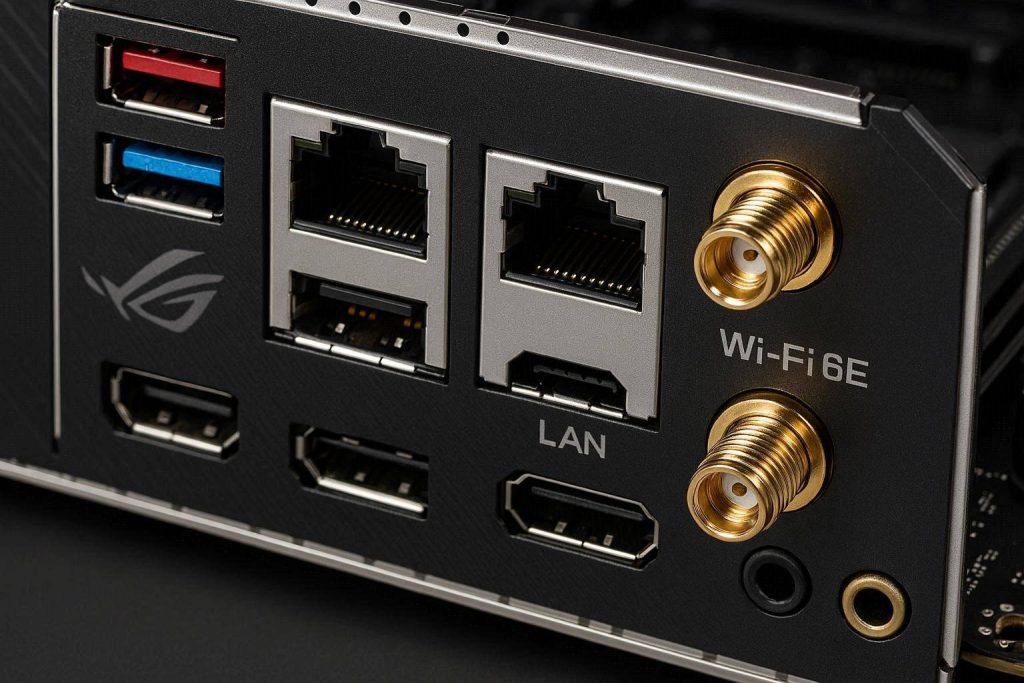
To solve this, the best gaming PC for 4K golf simulation must utilize a motherboard equipped with Dual LAN ports (two physical Ethernet jacks) or feature a dedicated Wi-Fi 6E PCIe expansion card.
This allows you to create strict network isolation. You can dedicate one hardwired gigabit Ethernet port exclusively to the launch monitor for zero-latency data transfer, while the high-speed Wi-Fi 6E handles your internet connection and Discord streams. This network separation guarantees that a random Windows background download will never interrupt the critical data packet containing your ball speed.
NVIDIA Control Panel Hacks for the Best Gaming PC for 4K Golf Simulation
Once your hardware is assembled, you must manipulate the software environment to force the PC to prioritize your golf round. The best gaming PC for 4K golf simulation is only as good as its operating parameters.
Open the NVIDIA Control Panel and navigate to “Manage 3D Settings.” First, locate the “Power Management Mode” and change it from “Normal” to “Prefer Maximum Performance.” This prevents the GPU from attempting to save power and down-clocking itself while you are standing over the ball.
Second, you must address the specific rendering demands of GSPro. Because GSPro does not natively support NVIDIA DLSS frame generation, you have two options. You can either utilize a third-party application like Lossless Scaling (available on Steam) to inject artificial frames, or you can manually optimize the in-game settings.
The biggest performance killer in any simulator is the “Tree Draw Distance.” In a 4K environment, rendering millions of individual leaves swaying in the virtual wind will crush even an RTX 4080. By simply lowering the tree draw distance by 15%, you free up massive computational headroom for the best gaming PC for 4K golf simulation, ensuring your frame rates stay locked at 60 FPS without any noticeable loss in visual quality.
The Premium Upgrade: Sourcing High-End Simulator Hardware
Attempting to buy a cheap, mass-market pre-built PC from a big box store is a guaranteed path to failure. Those machines use proprietary motherboards, inadequate power supplies, and restricted BIOS interfaces that make upgrades impossible.
To acquire the best gaming PC for 4K golf simulation without building it yourself, you must utilize boutique, high-end system integrators. Brands like SurfThing, Falcon Northwest, and Origin PC specialize in creating bespoke rigs tailored specifically for simulator environments. [INTERNAL LINK: Read our full review of the Top 5 High-End Prebuilt PCs for Simulators here.]
When sourcing these components or custom builds through specialized affiliate networks, ensure that the builder uses off-the-shelf, non-proprietary components. You want a standard ATX motherboard from brands like ASUS or MSI.
This guarantees that in three years, when course graphics become even more demanding, you can simply open the glass panel and swap in a new graphics card without having to throw the entire computer in the trash. The best gaming PC for 4K golf simulation is a modular investment that should grow and scale with your simulator bay over the next decade.
Power Delivery and Thermal Margins
Pushing a processor to 5.4GHz and running an RTX 5080 at maximum capacity generates an immense amount of heat and requires vast amounts of electricity. The best gaming PC for 4K golf simulation must be built on a foundation of flawless power delivery and thermal regulation.
Do not attempt to power a 4K simulator rig with a cheap power supply. You require an 850W to 1000W Power Supply Unit (PSU) with an 80+ Gold or Platinum rating. Furthermore, ensure the PSU is ATX 3.0 compliant, featuring the dedicated 12VHPWR cable required by modern NVIDIA graphics cards. This prevents voltage spikes from crashing the PC when you hit a booming drive and the screen rapidly transitions graphics.
Thermally, air cooling is no longer sufficient for these top-tier processors. The best gaming PC for 4K golf simulation must utilize a 360mm All-In-One (AIO) liquid cooler for the CPU. By pumping liquid across the processor block and dissipating the heat through a massive radiator mounted at the top of the case, you prevent the Intel Core Ultra 7 from reaching its 100-degree thermal throttling point. A cool PC is a fast PC, and maintaining these thermal margins ensures your hardware will easily survive years of heavy, daily use in your garage or basement.