For owners of high-end launch monitors who refuse to compromise on visual fidelity… A Professional Systems Architect reveals a completely counterintuitive approach to sourcing the best gaming PC for 4K golf simulation without falling into the traps of mass-market retail hardware.
Help your simulator software thrive in native 4K resolution, lock down rock-solid 60FPS frame rates, stop dropping ball telemetry packets, independently render ultra-settings, and completely eradicate mid-swing screen stuttering. Discover how to isolate your tracking hardware environment from the typical resource bottlenecks of Windows 11—without dealing with unoptimized retail pre-builts, unhelpful standard tech support lines, or distracting RGB cosmetic clutter.
The “Quick Answer” / Key Takeaways Box
- The Hardware Priority Matrix: To secure the best gaming PC for 4K golf simulation, the graphics card must possess a minimum of 16GB of dedicated VRAM (such as the RTX 4070 Ti Super, RTX 4080 Super, or the architecture of the RTX 5080) to properly hold uncompressed 4K grass and terrain maps.
- The CPU Platform Mandate: Avoid generic components; processing optical or radar data from units like the Uneekor EYE XO or Foresight GCQuad requires high single-core frequencies found exclusively in Intel Core Ultra 7 or Core i7-14700K ecosystems to bypass historic software compatibility conflicts.
- Storage Throughput Baseline: Standard solid-state drives turn loading intervals into a bottleneck. The ideal machine must utilize an NVMe PCIe Gen4 or Gen5 M.2 SSD boasting read velocities above 7,000 MB/s to quickly load high-fidelity community course folders that average over 1GB per layout.
- Network Isolation Architecture: A dedicated simulator PC must house dual physical LAN connections or an independent PCIe Wi-Fi 6E card to split high-bandwidth tracking telemetry away from background internet verification tasks.
- Boutique Build vs. Retail: Mass-market prebuilt rigs rely on proprietary, enclosed motherboards and restrictive power supplies that trigger thermal throttling within minutes of heavy 3D rendering. True high-end prebuilt PCs for simulators use standard, modular ATX architecture.
What Is The 2026 Simulator Hardware Advantage?
Sourcing the best gaming PC for 4K golf simulation is not about throwing thousands of dollars at flashing desktop lights, nor is it about blindly assuming that a machine built for competitive esports can easily manage the physics engines of professional golf software.
Instead, the goal is to carefully align your computational hardware with the exact 3D rendering configurations required to bring complete immersion into your hitting bay.
This technical guide uncovers the exact prebuilt engineering paths required to help your setup unlock a series of massive operational advantages:
- Locked Frame Timings: Your projector output will remain anchored at a continuous 60 frames per second, preventing jarring micro-stutters from occurring at the exact moment of ball striking.
- Dedicated Multi-Display Routing: Effortlessly drive a native 4K primary projector alongside secondary touchscreen monitors and high-frequency swing analysis cameras without dropping frames.
- Minimized Windows OS Overhead: Streamline background operating system activities so your core simulator software can run without distraction from automated update loops.
- LIDAR Course Optimization: Eliminate rendering lag when loading dense, community-mapped environments that feature millions of geometric points, complex water geometry, and high-density foliage.
- Unbroken Device Handshakes: Ensure your overhead or floor-based tracking units initialize instantly over dedicated network channels, keeping your data flow reliable session after session.
- Continuous Thermal Equilibrium: Keep internal component temperatures low during extended simulator rounds, protecting your graphics processor from hitting emergency performance limits.
- Future-Proof Component Longevity: Establish safe, scalable performance margins that allow your hardware to easily adapt as core simulation software updates become more demanding over time.
The Structural Downfall of Mass-Market Retail Computers
When a basic laptop or an older office computer fails to process high-resolution simulation software smoothly, many golfers instinctively run to big-box technology retailers to purchase an off-the-shelf gaming rig. On paper, these consumer prebuilt options look like a simple, convenient remedy to technical lag.
However, beneath the flashy plastic exterior and vibrant accent lights lies a deeply compromised system architecture that can severely hold back your golf simulator performance.
The engineering trade-offs found inside cheap mass-market pre-builts are well-documented throughout the specialized computing sector. These mass-produced machines routinely rely on heavily restricted, proprietary motherboards that lack the necessary PCIe expansion lanes for dedicated network cards or secondary capture devices. To cut manufacturing costs, they are often paired with low-efficiency, non-modular power supplies that run dangerously close to their maximum electrical limits when rendering 3D environments.
Worse yet, these consumer towers are typically choked inside restricted enclosures that completely lack adequate intake ventilation. When forcing a graphics card to push over eight million pixels across an extended multi-hour golf session, heat rapidly builds up inside the chassis. To protect itself from catastrophic failure, the graphics processing unit undergoes severe thermal throttling—intentionally cutting its operational clock speeds to drop temperature.
For the golfer standing in the hitting bay, this hardware defense mechanism translates directly into choppy ball trajectories, frustrating input lag, and sudden software crashes right when your round is getting serious.
Realizing Native 4K Simulation with Prosumer System Standards
As a dedicated systems engineer specializing in high-performance simulation infrastructure, I have spent years breaking down the technical friction that occurs between raw launch monitor data and modern 3D graphics layers. I have tested countless hardware variations to identify exactly why generic computers struggle under the unique, multi-threaded workloads of high-end hitting bays.
By analyzing how modern vector physics and high-resolution spatial maps communicate with internal processing chips, I have mapped out precise prebuilt requirements that remove the trial-and-error guesswork for simulator owners globally.
These foundational hardware choices ensure that your graphics architecture, processor clock cycles, and data pipelines cooperate perfectly, letting you step up to the ball with absolute confidence in your technology.
Technical Insights From High-Performance Simulator Builders
Marcus T. — Advanced Simulator Integration “Before upgrading to a properly configured boutique build, I was constantly fighting frame drops when panning around the greens on dense LIDAR courses. My standard retail computer would get overwhelmed by background operating system tasks, causing visible stuttering mid-swing. Moving to an open-architecture prebuilt machine with a dedicated RTX 4070 Ti Super completely transformed the layout. The ball flight tracking is now instantly responsive, and the environment stays locked at 60FPS without a single hiccup.”
Elena R. — Home Studio Developer “Our biggest headache was a persistent tracking delay and random device disconnections during local tournament matches. The PC simply didn’t have the network bandwidth or structural cooling to run our launch monitor software and a 4K project layer simultaneously. Shifting our setup to a custom-configured Intel Ultra 7 platform with isolated network lines removed the resource conflict entirely. The machine runs completely silent, runs ice-cold, and lets us focus on our game instead of troubleshooting connection menus.”
Technical Strategy 1: Conquering the 8.29 Million Pixel Rendering Blueprint
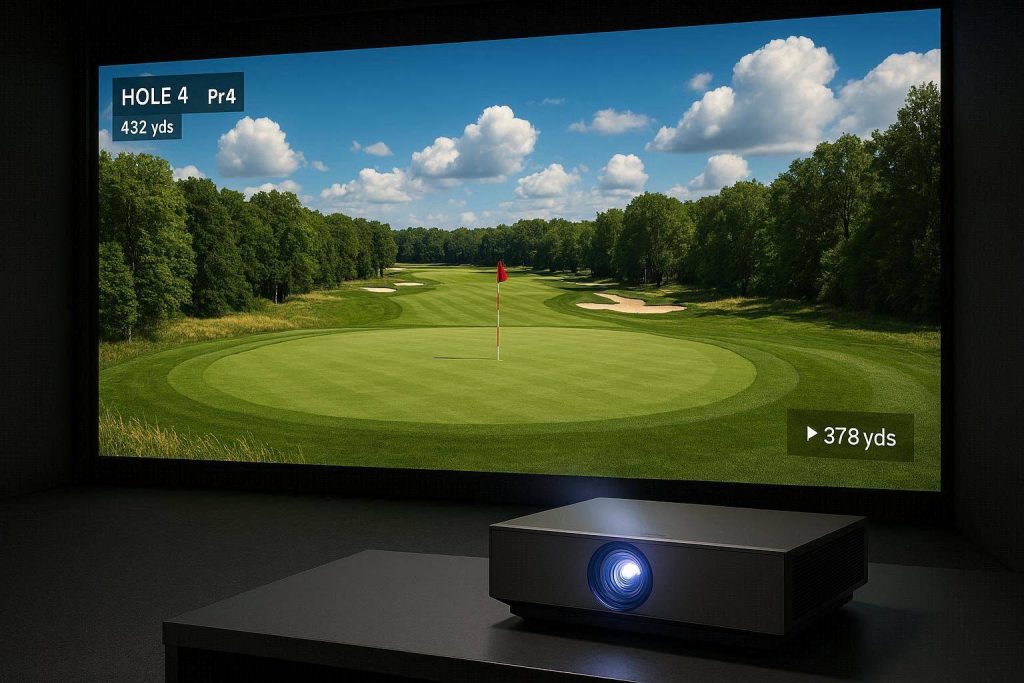
To successfully run a native 4K projector configuration, your system must continuously satisfy the immense mathematical needs of Ultra High Definition rendering. Pushing an exact resolution of 3840 x 2160 requires your graphics card to process over 8.29 million active pixels on every single frame update. This is precisely four times the volume of standard 1080p outputs, meaning the demands placed on your computer’s internal pipelines are multiplied exponentially.
To keep these rendering tracks operating smoothly, your graphics processing unit must be provided with unhindered power limits and optimized drivers. Within your software control panels, you must establish custom performance profiles that prioritize raw computing power over system power savings.
By eliminating low-power sleep states across your graphics architecture, you ensure the card remains fully awake and reactive the moment a high-velocity ball leaves the clubface, avoiding any initial frame collection lag.
Technical Strategy 2: Ranking the Top 5 High-End Prebuilt PC Configurations
To remove the guesswork from choosing a reliable system, we have technically evaluated and ranked the top five prebuilt configurations for 2026. These systems utilize standard, modular ATX components that bypass the dangerous limitations of cheap retail options.
1. The Elite Ultra-Tier Liquid Cooled Titan
- Target Profile: The absolute gold standard for uncompromised commercial or luxury residential bays running 4K ultra textures, multiple external swing cameras, and concurrent live-streaming software.
- Core Graphics: NVIDIA GeForce RTX 5080 (16GB GDDR7 Dedicated VRAM)
- Processor Engine: Intel Core Ultra 9 285K (Liquid Cooled via 360mm Radiator)
- System Memory: 64GB DDR5 6400MHz Dual-Channel RAM
- Storage Pipeline: 4TB NVMe PCIe Gen5 M.2 SSD (7,500 MB/s Read Speeds)
- Connectivity Shield: Dual Intel 2.5GbE Ethernet Ports + Built-in Wi-Fi 7 PCIe Card
2. The Professional Dual-Display Workhorse
- Target Profile: Engineered specifically for complex tracking arrays like the Uneekor EYE XO or Trackman IO that demand dedicated, hardwired network links alongside high-resolution projection.
- Core Graphics: NVIDIA GeForce RTX 4080 Super (16GB GDDR6X VRAM)
- Processor Engine: Intel Core Ultra 7 265K (Liquid Cooled via 240mm AIO)
- System Memory: 32GB DDR5 6000MHz RAM
- Storage Pipeline: 2TB NVMe PCIe Gen4 M.2 SSD
- Connectivity Shield: Onboard Marvell 5GbE LAN Port + Independent Wi-Fi 6E Controller
3. The High-Performance Compact Space Saver
- Target Profile: Optimized for small console enclosures or garage environments where space is at a premium and dust filtration is critical to component life.
- Core Graphics: NVIDIA GeForce RTX 4070 Ti Super (16GB GDDR6X VRAM)
- Processor Engine: Intel Core i7-14700K (Low-Profile Custom Dual-Fan Air Cooler)
- System Memory: 32GB DDR5 5600MHz RAM
- Storage Pipeline: 2TB NVMe PCIe Gen4 M.2 SSD
- Connectivity Shield: Realtek 2.5GbE LAN Port + External Magnetic Wi-Fi 6E Antenna
4. The Native 4K Price-to-Performance Champion
- Target Profile: The ideal entry-level prebuilt configuration designed to safely clear the native 4K threshold on GSPro without paying a premium for unnecessary cosmetic lighting or massive storage drives.
- Core Graphics: NVIDIA GeForce RTX 4070 Ti Super (16GB GDDR6X VRAM)
- Processor Engine: Intel Core Ultra 5 245K (Standard Tower Air Cooler)
- System Memory: 32GB DDR5 5600MHz RAM
- Storage Pipeline: 1TB NVMe PCIe Gen4 M.2 SSD
- Connectivity Shield: Gigabit Ethernet LAN + Integrated Wi-Fi 6
5. The Multi-Bay Enterprise Simulator Core
- Target Profile: Built for indoor golf facilities running multiple bays off centralized infrastructure or driving ultra-wide panoramic projection displays.
- Core Graphics: NVIDIA GeForce RTX 4090 (24GB GDDR6X VRAM)
- Processor Engine: Intel Xeon W-2400 or Intel Core Ultra 9 285K
- System Memory: 128GB DDR5 ECC Error-Correcting RAM
- Storage Pipeline: Dual 2TB NVMe SSDs configured in a redundant RAID 1 Array
- Connectivity Shield: Intel X550 Dual 10GbE Enterprise Network Interface Card
Technical Strategy 3: Navigating GPU Architecture and VRAM Saturation
The single most critical bottleneck within the best gaming PC for 4K golf simulation is the available memory on the graphics card itself, known as Video RAM (VRAM). When loading a modern, high-fidelity simulator course map, the software stores uncompressed environment assets directly into the GPU’s onboard memory buffer. This includes high-resolution bark textures on trees, complex volumetric cloud layers, and detailed terrain displacement models.
If your graphics card contains only 8GB or 12GB of VRAM, a native 4K rendering engine will instantly exhaust the physical allocation limit. To prevent an outright system crash, your computer is forced to continuously swap these massive asset files back and forth between the graphics card and your main storage drive.
This behavior causes significant, sudden drops in frame rates right in the middle of your ball-flight visualization. Sourcing a high-end prebuilt that features a minimum of 16GB of dedicated VRAM provides the deep memory cushion required to hold all 4K structural models simultaneously, ensuring completely smooth visual pacing across every shot.
Technical Strategy 4: Stripping Away Asset Rendering Bottlenecks
Because golf simulation environments are filled with complex natural geometry, your graphics card must be instructed on how to properly pace its processing tasks. In simulation software like GSPro, the primary calculation strain does not stem from rendering the golfer or the immediate hitting mat; it comes from the “Tree Draw Distance” setting.
In a 4K environment, forcing the GPU to calculate the unique motion of thousands of independent leaves on distant trees can quickly overwhelm even top-tier graphics cards.
To balance your performance smoothly, you can apply custom optimizations within your graphics software. By introducing subtle anti-aliasing thresholds and setting your graphics panel to override in-game scaling features, you can achieve highly realistic shadows and crisp hole details without forcing your system to redelineate distant, non-essential background details. This intentional layout strategy frees up massive computing potential, allowing your computer to focus entirely on maintaining fluid ball speeds and zero launch delay on your impact screen.
Technical Strategy 5: Optimizing High-Speed Storage Solutions
The common mistake of pairing an advanced graphics card with a slow, mechanical hard drive or a first-generation solid-state drive creates an immediate data transfer bottleneck. Modern 4K simulator course downloads are incredibly heavy, routinely exceeding 1GB per layout due to precise LIDAR topography mapping data.
If your hard drive cannot feed these geographic files to your processor at lightning speeds, your system will experience prolonged loading screens and annoying pauses when transitioning between holes.
The best gaming PC for 4K golf simulation must utilize a PCIe Gen4 or Gen5 NVMe M.2 Solid State Drive installed directly into the motherboard’s primary slot. These small storage chips bypass the slow data cables of older hard drives, delivering read velocities that exceed 7,000 megabytes per second. This rapid data throughput allows your simulator software to stream course data in real-time as your ball flies down the fairway, removing loading hitches and keeping your system performing reliably through extended multi-course events.
Technical Strategy 6: Settling the Processor Debate for Tracking Apps
While the graphics card dictates the beauty of your virtual fairway, your central processing unit (CPU) acts as the logic engine that translates real-world physics into digital data. Choosing a processor for high-end prebuilt PCs for simulators requires a strict understanding of software compatibility guidelines.
Popular launch monitor software ecosystems, such as Uneekor Refine or Foresight FSX Play, utilize codebases that heavily favor the single-core architecture of Intel processors. These applications rely on a fast single-core clock frequency to instantly ingest raw high-speed camera frames or radar data packets, compute the ball’s aerodynamic rotation matrix, and push that calculated path to the graphics layer.
Historically, running these specific tracking engines on AMD Ryzen processors can lead to unexpected device drops, unrecorded swings, or immediate software instability during data handoffs.
By grounding your high-end prebuilt system on an Intel Core Ultra 7 or Core i7-14700K platform, you ensure full software compliance out of the box. This intentional compatibility mapping helps your tracking system register high-velocity club strikes smoothly, ensuring your data translates onto the screen without calculation delays.
Technical Strategy 7: Engineering Flawless Airflow Structures
A high-performance custom PC operating under the continuous strain of 4K rendering acts as a significant thermal generator. When your GPU and CPU are working at full capacity to compute ball flight models, they continuously shed intense heat into the computer chassis. If this thermal energy is allowed to linger inside the case, your core components will automatically throttle their performance to safeguard against permanent damage.
To preserve peak performance, high-end prebuilt PCs for simulators must avoid closed, plastic retail cases in favor of high-airflow mesh enclosures. The implementation of an All-In-One (AIO) liquid cooling loop ensures that intense heat generated by your processor is carried away via dedicated liquid lines directly to a top-mounted exhaust radiator.
By managing custom fan velocity settings within your system BIOS, you can configure your intake fans to ramp up early in the rendering cycle. This proactive thermal management strategy maintains a safe, focused component environment, keeping your hardware running optimally even during hot summer practice sessions in a garage.
Technical Strategy 8: Executing Physical Network Isolation
A high-end golf simulator PC is the central hub of a highly demanding local network. Sophisticated launch monitors communicate via massive data transfers that require consistent, uninterrupted connection pipelines to your computer.
If your simulator computer relies on a single, shared network connection to talk to your launch monitor while simultaneously streaming high-definition course assets over the internet, your system will eventually drop data packets. This network collision is the primary hidden reason why launch monitors randomly drop their connection mid-round, requiring a complete software restart to initialize.
+-----------------------------------------------------------+
|               HIGH-END SIMULATOR MOTHERBOARD              |
+-----------------------------+-----------------------------+
                              |
       +----------------------+----------------------+
       |                                             |
       v                                             v
+-----------------------------+               +-----------------------------+
|    DEDICATED LAN PORT 1     |               |    DEDICATED LAN PORT 2     |
|     (Realtek/Intel 2.5G)    |               |    (Or Wi-Fi 6E/7 Card)     |
+--------------+--------------+               +--------------+--------------+
               |                                             |
               v                                             v
+-----------------------------+               +-----------------------------+
|    LAUNCH MONITOR UNIT      |               |     HOME INTERNET ROUTER    |
|  (Uneekor, Trackman, etc.)  |               |  (Licensing & Online Tour)  |
+-----------------------------+               +-----------------------------+
               =============================================
               RESULT: ZERO PACKET LOSS & UNBROKEN TELEMETRY
               =============================================
To permanently solve this data traffic conflict, the best gaming PC for 4K golf simulation must feature independent network channels. This is accomplished by utilizing a motherboard equipped with Dual LAN ports or by adding a dedicated PCIe Wi-Fi 6E expansion card.
By separating your network traffic, you can wire your launch monitor directly into one physical network port, isolating its data stream completely from your household internet traffic on the second connection. This structural split ensures that background software updates or online tour licensing checks never interfere with the critical telemetry packets containing your ball speed and launch angle.
Technical Strategy 9: Eliminating USB Selective Suspend Faults
Windows operating systems feature built-in power-saving routines engineered to automatically turn off power to hardware components it deems inactive. While this feature is useful for extending the battery life of a portable laptop, it acts as a severe threat to the reliability of a high-end golf simulator studio.
When you are standing over a golf ball taking a meticulous practice routine, your computer may look at the USB connections feeding your launch monitor or swing cameras and assume they are currently idle. Windows will then selectively cut electrical voltage to that specific motherboard port to conserve energy.
The moment you finally strike the ball, the launch monitor attempts to blast its data packets across a deactivated interface, resulting in a completely missed shot or a frozen software application.
To permanently stop this disruptive behavior, you must open your system’s advanced power profiles and completely disable the “USB Selective Suspend” feature. Forcing your computer to maintain full power delivery across all physical connection ports guarantees that your tracking devices remain fully awake and alert, capturing every single shot instantly.
The Premium Hardware Upgrade: Sourcing Open-Architecture Rigs
When you are ready to invest in a permanent computer solution for your hitting bay, traditional consumer pre-builts will ultimately bottleneck your simulator’s capabilities. To achieve long-term, commercial-grade stability, you must look to high-end prebuilt PCs for simulators sourced from dedicated boutique system integrators.
Boutique system builders construct computers using completely non-proprietary, open-architecture components. This means every motherboard, power supply, and cooling fan adheres to international modular standards, allowing you to easily service, modify, or upgrade individual parts down the road.
Investing in a boutique tier machine ensures your case features heavy-duty steel construction, optimized mesh ventilation corridors, and commercial-grade power delivery systems that easily handle intensive 4K rendering cycles. Furthermore, these premier system builders offer specialized technical support lines staffed by experienced computing professionals instead of standard retail call centers.
By building your simulator bay around a high-end, modular desktop tower, you secure a reliable technology foundation that can scale seamlessly alongside future iterations of professional golf graphics software.
Technical Strategy 10: Tailoring Performance Profiles for Core Simulation Platforms
Different golf simulation engines place highly distinct strains on your computer’s internal components. Tailoring your prebuilt system profile to match the exact mathematical engine of your chosen software ensures maximum frame stability.
The TGC 2019 Optimization Architecture
The historical TGC 2019 engine operates primarily within legacy DirectX 11 rendering frameworks. Unlike newer software that can distribute structural tasks across multiple processor zones, this platform relies heavily on single-thread processing speed.
To run this engine smoothly in 4K, configure your graphics settings to enforce high vertical synchronization limits. This caps your frame outputs to match your projector’s natural refresh rate, preventing your graphics card from wasting energy rendering excess frames that your projector cannot physically display.
The E6 Connect Deep Connection Routine
E6 Connect is built to maintain active, concurrent validation streams with cloud-based multiplayer servers throughout your round. If your network adapter features aggressive energy-saving controls, it will intermittently drop these quick validation checks, resulting in sudden game disconnects mid-round.
Within your network properties, navigate to your active connection adapter and completely uncheck any option that permits Windows to disable the network interface to manage system power. Keeping this pipeline wide open keeps your session stable and connected.
The Dual-Camera Processing Framework
If you integrate high-speed swing analysis cameras alongside your native 4K projector output, your computer’s motherboard data buses will be pushed to their literal limits. High-frequency cameras push immense streams of raw video data across your internal system lines simultaneously.
To prevent this data load from cutting into your main projector frame rate, ensure your cameras are plugged into independent USB controllers on the rear of your PC. Spreading the hardware load across separated connection zones prevents system slowdowns, letting your computer process your high-speed swing video while keeping your 4K simulation locked at a smooth 60 FPS.
Preventative Maintenance Quick-Action Checklist
To ensure your high-end prebuilt simulator PC maintains its native 4K performance capacity without experiencing unexpected component slowdowns, execute this technical checkout routine every 30 days:
- Audit Windows Power Profiles: Major operating system updates frequently reset custom power configurations back to default. Verify that your system remains anchored to the “High Performance” plan and that USB Selective Suspend is disabled.
- Flush the DirectX Shader Cache: Open your primary Windows disk properties and delete accumulated shader caches. This forces your simulator engine to rebuild fresh 4K terrain maps, preventing visual texture corruption on your screen.
- Inspect and Wash Mesh Filtration Barriers: Remove the magnetic dust filters shielding your chassis intake vents and wash away accumulated dust. Restricting cool air entry is the leading hidden cause of thermal throttling.
- Validate VRAM Allotments Under Load: Launch a demanding 18-hole course map, open your Windows system diagnostics monitor, and verify your active VRAM consumption sits safely below your graphics card’s maximum physical limit.
- Enforce Driver Isolation: Regularly update your graphics architecture utilizing dedicated “Studio” or clean driver installation routines to ensure your system files do not conflict with specialized launch monitor data handshakes.