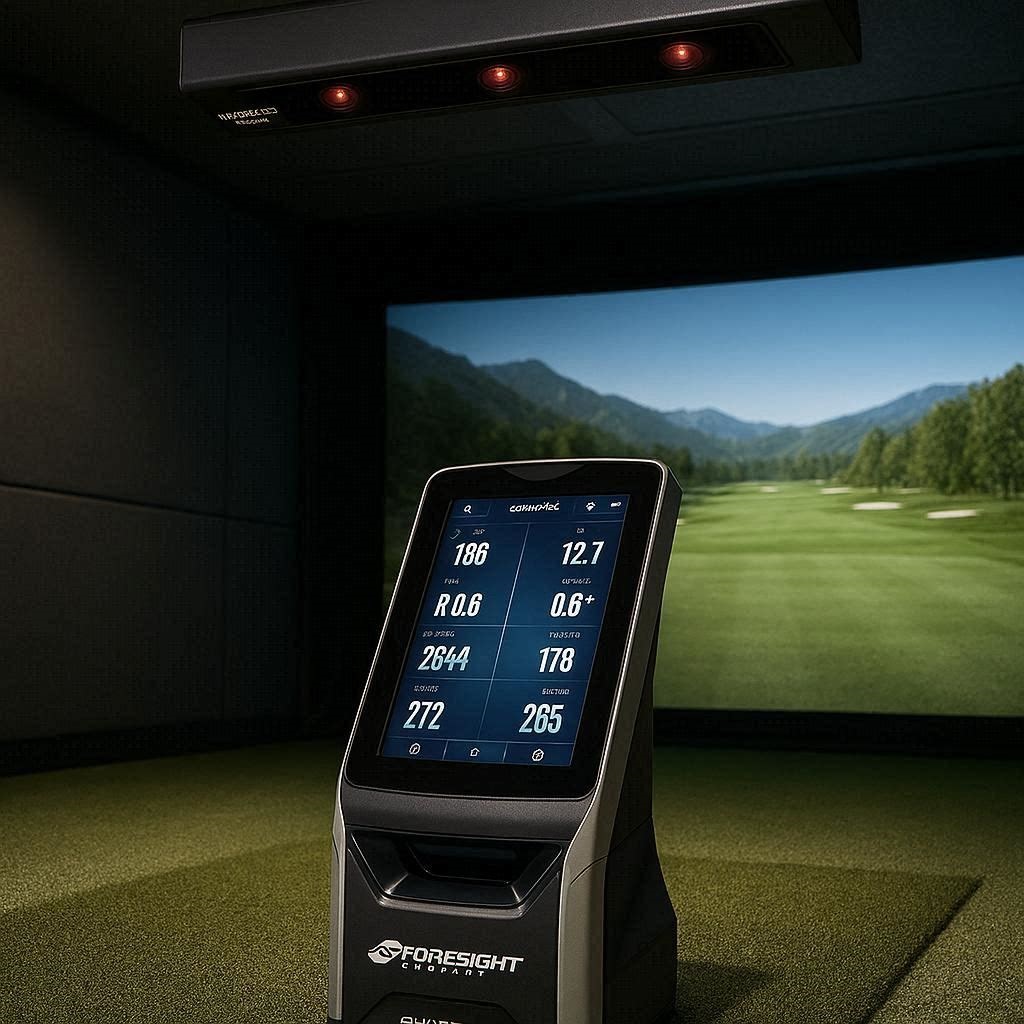
When building a high-ticket residential or commercial indoor golf bay, selecting the foundational tracking technology dictates your entire configuration. The head-to-head matchup of the Foresight Sports QuadMAX vs Uneekor EYE XO2 represents the absolute peak of premium residential golf hardware. Both systems occupy elite pricing tiers but achieve their precision through radically different engineering architectures.
Choosing between a floor-mounted quadrascopic camera array and an overhead triple-camera infrared matrix is more than a preference. It fundamentally impacts your room geometry, hitting zone flexibility, and long-term software licensing costs. Investing in this tier requires a granular look at the data points, sensor arrays, and deployment limitations of these two powerhouses.
The Quick Answer / Key Takeaways
- System Form Factor: The QuadMAX is a highly portable, floor-standing unit that easily transitions from an indoor bay to an outdoor practice range. The EYE XO2 is a permanently mounted ceiling fixture designed for dedicated indoor simulator installations.
- Hitting Envelope: The EYE XO2 features a massive 28-inch by 21-inch hitting area that allows natural left-handed and right-handed play without physical adjustments. The QuadMAX offers a more concentrated 18-inch by 14-inch capture zone.
- Tracking Technology: Both systems rely on ultra-high-speed photometric sensors. The QuadMAX leverages four advanced high-speed cameras, while the EYE XO2 utilizes a three-camera overhead infrared matrix.
- Data Processing: The QuadMAX features an onboard touchscreen displaying telemetry directly on the device with localized storage capability. The EYE XO2 depends entirely on a constant hardwired connection to a high-powered gaming PC.
- Licensing Model: Foresight includes lifetime core software licenses with no mandatory annual fees. Uneekor relies on a tiered annual subscription structure to unlock third-party software connectivity.
Architectural Breakdown: Sensor Engineering and Physics
To truly appreciate the performance vectors of the Foresight Sports QuadMAX vs Uneekor EYE XO2, we must look directly at the underlying optical physics. How these machines view the golf ball at the exact microsecond of impact defines their real-world reliability.
Quadrascopic Photometric Array (QuadMAX)
The hardware chassis of the QuadMAX features four ultra-high-speed optical sensors calibrated to capture stereoscopic images at jaw-dropping frame rates. This quadrascopic alignment allows the unit to build a true three-dimensional spatial profile of the ball and club head. By positioning the sensors on the ground directly adjacent to the ball, the system captures clear, high-resolution imagery of the physical dimple compression.
The on-board processing unit features an advanced field-programmable gate array layout. This computing core extracts data from up to two billion individual data points per shot cycle. Because the light source is tightly focused within the compact ground-based camera housing, it is largely impervious to ambient room lighting, flickering projectors, or sunlight interference.
[IMAGE PLACEHOLDER: Technical illustration showcasing the four-camera optical lens placement on the front of the device + Alt Text: Foresight Sports QuadMAX four-camera lens configuration and internal sensor layout]
Triple-Camera Overhead Infrared Matrix (EYE XO2)
Suspended directly above the player, the EYE XO2 utilizes a wider physical enclosure housing three specialized high-speed infrared cameras. This wide-angle overhead configuration acts as a multi-directional optical net. The third camera lens was introduced specifically to eliminate the peripheral blind spots common in dual-sensor ceiling installations.
The overhead array is supported by a powerful built-in infrared flash array. When a ball moves through the hitting box, the cameras capture rapid-fire silhouettes against the dark backing turf. This overhead vantage point provides a completely unobstructed view of the entire hitting mat. It completely removes any physical hardware from the floor, preserving an authentic open-space aesthetic.
Data Point Benchmarks: Ball Flight and Club Integration
Precision tracking means nothing if the system cannot output every critical metric required to diagnose structural swing flaws. Both monitors capture elite, tour-validated datasets, but their extraction methods vary.
Ball Launch Telemetry
The ball data metrics for the Foresight Sports QuadMAX vs Uneekor EYE XO2 match the performance characteristics seen on professional tours. Both devices measure ball speed, total spin, spin axis, horizontal launch angle, vertical launch angle, and peak apex.
The EYE XO2 captures this information using its proprietary Dimple Optix software processing engine. The system does not require specially marked golf balls. Instead, the triple-camera overhead sensors read the high-contrast movement of the natural dimples against the cover material. Spin axis and true spin rate are calculated instantaneously.
The QuadMAX processes ball telemetry using direct optical imagery from its floor position. Because it sits inches from the strike zone, it directly captures initial velocity changes and exact spin vectors without mathematical modeling. For players demanding absolute certainty on high-spin wedge shots or low-spin driver strikes, the ground-based perspective remains the industry benchmark.
Club Tracking and Impact Analysis
To maximize the club tracking capabilities of both launch monitors, players must use face-applied reflective markers. The differences in application and visual output are distinct.
+--------------------------+----------------------------+----------------------------+
| Metric Parameter         | Foresight QuadMAX          | Uneekor EYE XO2            |
+--------------------------+----------------------------+----------------------------+
| Sensor Location          | Ground-Based (Side Mat)    | Ceiling-Mounted (Overhead) |
| Marker Requirement       | 4-Dot Reflective Fiducial  | 2-Dot/Reflective Stickers  |
| Hitting Area Size        | 18" x 14"                  | 28" x 21"                  |
| On-Board Touchscreen     | Yes (Customizable Tiles)   | No (PC Dependent)          |
| Raw Club Data Points     | Comprehensive (Lie/Loft)   | Comprehensive (Path/Face)  |
| Slow-Motion Playback     | Via Connected Software     | Native Club Optix Video    |
+--------------------------+----------------------------+----------------------------+
The EYE XO2 features a highly popular tool known as Club Optix. Because the cameras look directly down onto the clubface during the entire hitting zone entry, the system creates a true, crystal-clear slow-motion video replay of your club striking the ball. You see the exact millimeter of face contact alongside numeric metrics for club path, face angle, angle of attack, and dynamic loft.
The QuadMAX utilizes a highly precise 4-dot reflective fiducial marker system applied to the clubface. By tracking these four specific spatial points, the quadrascopic system monitors complex twisting and deflection at impact. It measures exact closure rate, club path, face-to-path relationship, angle of attack, impact location, and precise loft/lie adjustments at the critical moment of separation.
Spatial Geometry and Environmental Constraints
Your room dimensions are the absolute gatekeeper when deciding between the Foresight Sports QuadMAX vs Uneekor EYE XO2. If your physical space does not meet the necessary technical criteria, the system will experience dropped shots or compromised safety.
Ceiling Height and Clearance Hurdles
The EYE XO2 demands rigid compliance regarding ceiling height. The structural chassis must be securely anchored between 9 feet and 10 feet above your hitting turf. If your ceilings are lower than 9 feet, the camera lenses cannot map a wide enough field of view to utilize the 28-inch hitting area. If your ceilings exceed 10 feet, you must install custom drop-down structural framing to bring the unit back within its optimal functional envelope.
The QuadMAX offers immense flexibility regarding room height. Because it sits entirely on the floor, your ceiling height constraints are defined purely by your physical stature and swing path. If you can comfortably swing a driver without hitting your ceiling, the QuadMAX will function perfectly.
Hitting Zone Envelopes and Multi-Player Use
If you regularly host simulator nights with a mix of right-handed and left-handed golfers, the room width and hitting zone layout become paramount. This is where the ceiling-mounted architecture holds a distinct advantage.
The EYE XO2 provides a massive 28-inch wide hitting zone. This allows both left-handed and right-handed players to stand in their natural positions and strike balls from the exact same central tee location. There is absolutely no need to move hardware, reset tracking software, or re-calibrate cameras mid-round.
The QuadMAX has an 18-inch by 14-inch capture zone. When a right-handed player finishes their turn and a left-handed player steps up, the physical launch monitor must be picked up and moved to the opposite side of the hitting mat. While this process is fast due to the unit’s automatic internal leveling sensors, it breaks the organic pacing of multi-player matches.
Software Infrastructure, Licensing, and Operational Costs
The initial hardware purchase is only part of the financial equation. The digital ecosystems supporting the Foresight Sports QuadMAX vs Uneekor EYE XO2 operate under entirely different long-term economic structures.
The Turnkey Foresight Ecosystem
Foresight Sports includes a comprehensive software suite directly with the baseline hardware package of the QuadMAX. Out of the box, owners receive perpetual lifetime licenses for:
- FSX Play (Ultra-HD simulation engine)
- FSX 2020 (Classic practice and game suite)
- FSX Pro Performance Analysis
- Full Awesome Golf Lifetime Membership
There are no mandatory annual subscription fees to access your data or play the core courses. Once you buy the hardware, your software access is completely bulletproofed against future paywalls.
The Tiered Uneekor Subscription Matrix
Uneekor utilizes their high-performance VIEW software platform as the control center for the EYE XO2. While basic data access and practice tools are free under the baseline tier, connecting to popular third-party simulation software like GSPro or E6 Connect requires entering a tiered subscription structure.
To bridge your hardware data to external software platforms, you must maintain at least the Pro Tier subscription, which incurs an annual fee of $199. Upgrading to the Champion Tier ($399/annually) or Ultimate Tier ($599/annually) unlocks advanced features such as their comprehensive AI Trainer module, multi-sport modules, and cloud-hosted historical performance data profiles.
[EXTERNAL LINK: Technical comparison of graphics engine rendering times for simulator software]
Premium Integration: Upgrading Your Enclosure Component Stack
Deploying components of this caliber requires upgrading your entire environment to eliminate data bottlenecks and prevent structural damage to your property.
Premium Fiber-Forgiving Hitting Mats
High-speed camera launch monitors capture the exact club behavior through the turf interaction zone. Standard, low-tier driving range mats use rigid nylon fibers glued over thin foam padding. When your club strikes these harsh surfaces, it bounces unnaturally. This artificial deflection skews the angle of attack and dynamic loft readings on both the QuadMAX and EYE XO2.
[IMAGE PLACEHOLDER: Cross-section visual showing premium turf fiber layers designed to mimic real grass root structures + Alt Text: Industrial grade multi-layer golf simulation hitting strip designed to absorb club impact]
Upgrade your hitting bay with a premium, deep-pile stance mat featuring a modular hitting strip insert. Strips like those from Fiberbuilt or professional-grade continuous turf options allow the club head to slide down and through the ball naturally. This ensures your indoor swing data perfectly mirrors your outdoor on-course numbers while protecting your wrists and elbows from repetitive stress injuries.
Heavy-Duty Structural Enclosures and Fabric Tensioning
A fast driver swing generating ball speeds north of 160 MPH carries immense kinetic energy. To safely handle this power, your impact screen must be woven from high-density, multi-layer polyester fibers designed specifically for close-range acoustic dampening and high velocity impacts.
Ensure your screen frame utilizes heavy-duty steel piping wrapped in high-impact foam padding. The screen tension must be finely balanced. If the screen is too loose, your projection image will sag and distort. If it is tensioned too tightly, the screen transforms into a dangerous trampoline, sending golf balls rebounding back toward the golfer or hitting the ceiling-mounted EYE XO2 system directly.
Advanced Shielded Data Infrastructure
Both devices process immense volumes of optical telemetry data every second. Any drop in bandwidth along your local network will lead to frustrating processing delays or completely dropped shots.
- For the EYE XO2: Avoid standard wireless bridges or cheap network switches. Run a dedicated, shielded Cat6a Ethernet cable directly from the sensor chassis into the dedicated LAN port of your simulation PC.
- For the QuadMAX: While the onboard screen allows standalone use, connecting to a PC should be handled via a high-bandwidth, heavy-duty USB-C connection or a dedicated wired network link to prevent wireless latency spikes during heavy graphics rendering cycles.
Custom Tuning and System Preservation Hacks
To maximize the functional lifespan of your premium tracking investment, implement these two pro-level maintenance routines.
The Anti-Static Lense Mitigation Hack
Indoor simulator rooms generate substantial static electricity due to friction between the golf ball, impact screen fibers, and synthetic turf. This static charge turns the camera lenses of your launch monitor into a magnet for fine dust and ambient debris.
Never clean the delicate glass lenses of the QuadMAX or EYE XO2 with an ordinary household shirt or a standard industrial microfiber rag, as trapped micro-particles can permanently scratch the specialized anti-static optical coatings. Instead, utilize a manual DSLR camera lens blower to dislodge surface dust, followed by a specialized camera-grade lens cleaning wipe.
Mirror Alignment Calibration Tracking
For ceiling installations like the EYE XO2, subtle vibrations caused by heavy foot traffic on floors above can slowly knock the sensor housing out of alignment over time.
- Lay a high-contrast cross-line laser level directly on your hitting mat.
- Align the laser perfectly with the physical tee position.
- Project the vertical line up to the sensor casing to quickly verify that the unit has not shifted off-axis.
- Executing this rapid check monthly guarantees your horizontal launch and spin axis values remain perfectly true to your target line.
[INTERNAL LINK: Comprehensive Troubleshooting Guide for Indoor Golf Simulator Alignment Errors]