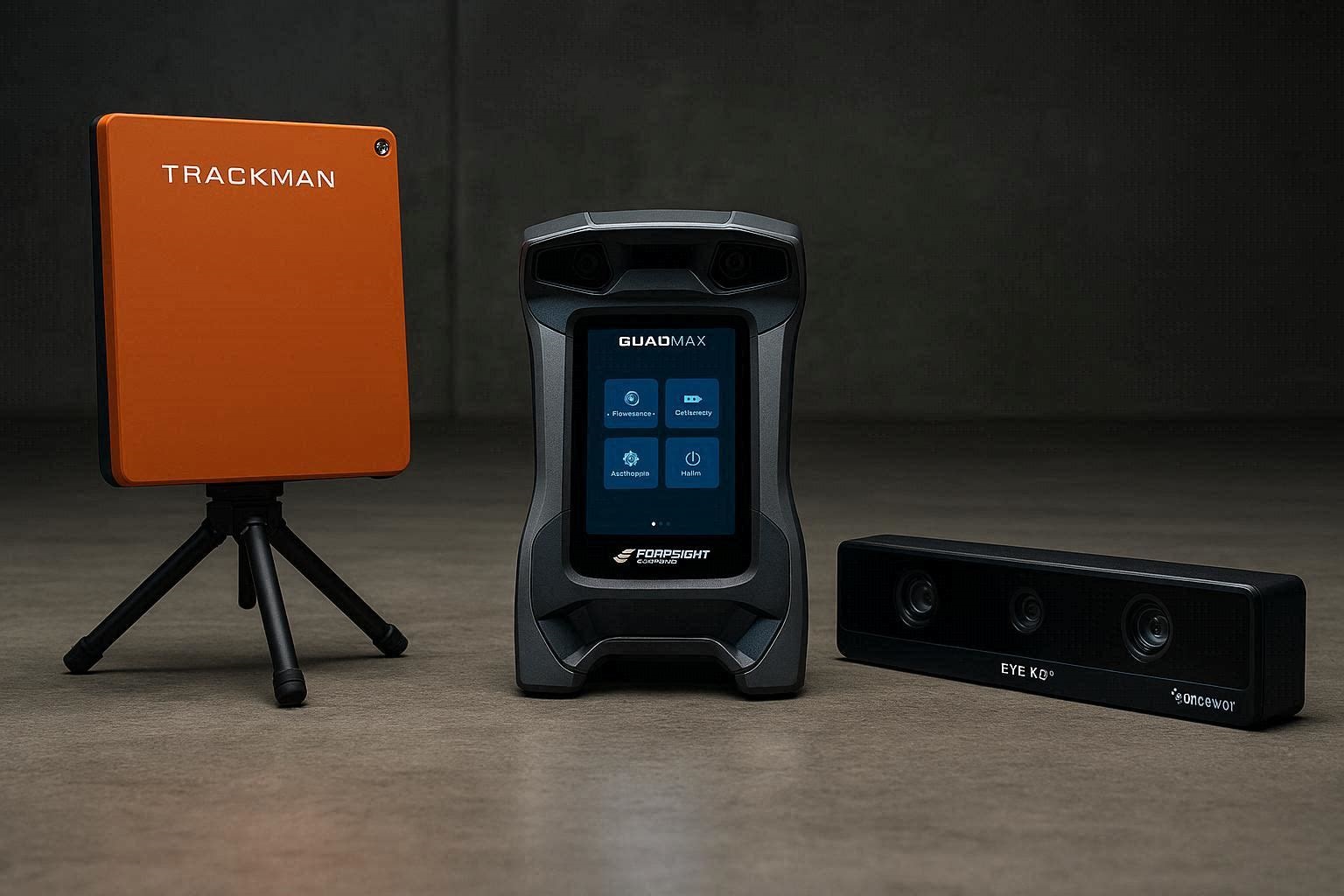
Architecting a luxury residential simulator or engineering a multi-bay commercial golf center requires making a permanent choice regarding your tracking hardware. At the highest tier of the market, the decision universally comes down to three dominant giants: the dual-radar Trackman 4, the ground photometric Foresight Sports QuadMAX, and the ceiling-mounted overhead Uneekor EYE XO2. Each of these systems commands a five-figure investment, yet they capture club and ball analytics through entirely distinct branches of physical engineering.
Choosing the wrong technology stack for your specific building layout will result in critical dropped data points, structural room interference, or misread ball flights that destroy the realism of your simulation. If you are referencing standard marketing copy or looking through the data sheet files like Sales Page Copy [SELECT ALL TEXT & COPY]_4.docx, you will quickly find that generalized descriptions do not cover the strict physical space thresholds, processing frameworks, and sensor limitations encountered during a high-end build. This exhaustive technical benchmark will deconstruct the sensor arrays, algorithmic models, and space requirements of these three systems to ensure your simulator bay delivers flawless accuracy.
The Quick Answer / Key Takeaways
- Core Tracking Physics: Trackman 4 uses Dual Doppler Radar tracking combined with synchronized camera optics. Foresight QuadMAX utilizes a ground-based Quadrascopic (four-camera) photometric array. Uneekor EYE XO2 uses an overhead, ceiling-mounted triple-camera infrared matrix.
- Space Adaptation: Trackman 4 demands significant physical depth and is highly sensitive to indoor metallic or electrical interference. The QuadMAX offers the highest spatial flexibility on the ground, while the EYE XO2 frees up all floor space but requires rigid ceiling heights.
- Hitting Box Volume: The Uneekor EYE XO2 provides the largest uninterrupted hitting footprint at 28 inches by 21 inches, enabling seamless left and right-handed play. The QuadMAX provides an 18-inch by 14-inch zone, while the Trackman 4 tracks a wide area but requires clear sightlines from 8 to 10 feet behind the ball.
- Club Metric Integrity: QuadMAX and EYE XO2 capture direct, measured visual profiles of impact location and club deflection using reflective face markers. Trackman 4 derives its data via secondary radar sweeps, which can struggle in short-indoor configurations if the environment is not mathematically tuned.
- Data Independence: The QuadMAX features full on-board processing, internal memory, and an interactive customizable touchscreen interface. The Trackman 4 and EYE XO2 are entirely dependent on continuous data streams to a dedicated high-performance gaming computer.
Technical Sensor Architecture and Computational Physics
To maximize the performance of your indoor golf studio, you must understand the exact manner in which these tracking systems capture initial launch dynamics. Merely comparing data outputs on a screen ignores the massive differences in how these units view the hitting zone.
Trackman 4: Dual Doppler Radar and Camera Fusion
The Trackman 4 utilizes two independent radar antennas working in synchronous frequency modulation. One radar specializes purely in tracking ball flight from the moment of compression until impact with the screen, measuring velocity vector changes, spin decay, and true curvature. The second radar focus is concentrated entirely on the sub-millisecond event of the club head entering the hitting zone, tracking club path, face angle, and horizontal plane changes.
This dual-radar matrix is bolstered by a built-in high-speed optical camera sensor. The camera acts as an alignment tool and syncs with the radar to pinpoint the exact starting coordinates of the ball. Because radar tracks the displacement of objects through electromagnetic wave reflections, the Trackman 4 requires a totally unobstructed path between the radar face, the ball, and the impact screen to prevent signal degradation.
Foresight Sports QuadMAX: Quadrascopic Photometric Array
The Foresight Sports QuadMAX operates completely independently of radar waves. It relies on a ground-based quadrascopic camera array positioned parallel to the target line. Four ultra-high-speed optical sensors capture stereoscopic images at several thousand frames per second, freezing the golf ball at impact.
The internal processing architecture uses an advanced array to analyze the precise movement of the ball’s dimples against a high-contrast background. Because the cameras sit less than two feet from the ball, the system directly measures initial launch parameters with zero reliance on downstream flight tracking. The QuadMAX light spectrum is tightly controlled by integrated infrared arrays within the chassis, rendering it completely immune to fluorescent bulb flicker or external ambient light pollution.
Uneekor EYE XO2: Overhead Triple-Camera Infrared Matrix
Suspended permanently from the ceiling frame, the Uneekor EYE XO2 deploys three high-speed cameras arranged in a precise triangular pattern. This configuration introduces a third optical lens to solve the peripheral distortion issues that can occasionally impact dual-camera overhead designs.
The EYE XO2 uses high-powered infrared LED flashes to illuminate the hitting area from above. When the club head enters this zone, the three sensors capture synchronous images against the dark turf backing. The computational system uses these overlapping images to triangulate both ball spin vectors via dimple tracking technology and club head delivery angles. This completely clears the floor area of any wires, boxes, or alignment sticks.
Hitting Envelopes, Spatial Boundaries, and Room Geometry
Before executing structural modifications to a garage or commercial room, you must verify that your physical spatial volume matches the strict constraints of your chosen launch monitor. Failing to respect these boundaries will cause permanent tracking anomalies.
[IMAGE PLACEHOLDER: Full 3D room diagram contrasting radar depth requirements against overhead camera positions + Alt Text: High-end golf simulator floor plan outlining space requirements for Trackman 4 vs Foresight Sports QuadMAX vs Uneekor EYE XO2]
Trackman 4 Spatial Depth Requirements
Indoor radar tracking requires substantial physical depth to operate with tour-grade precision. The Trackman 4 must be positioned exactly 8 to 10 feet behind the tee position, sitting perfectly level with the hitting surface on its integrated tripod stand. Furthermore, the distance from the tee to the impact screen must be a minimum of 10 to 12 feet.
This creates a mandatory total room depth requirement of 18 to 22 feet. If your room is shorter than 18 feet, the radar antennas will not have enough physical time to track the initial radar frequency shifts before the ball strikes the screen, resulting in calculated or estimated spin data rather than direct measurements.
Uneekor EYE XO2 Ceiling Height Restrictions
Overhead arrays transfer the spatial pressure from the floor to the ceiling. The EYE XO2 demands an exact mounting height between 9 feet and 10 feet above the premium turf plane. If your ceiling height falls below 9 feet, the camera lenses cannot achieve the wide focal path required to track the expanded 28-inch by 21-inch hitting area.
The horizontal positioning must place the forward edge of the EYE XO2 casing exactly 3.5 feet in front of the tee position. Because the unit is anchored overhead, the total required room depth is compressed down to a highly manageable 15 feet, assuming you have enough physical space to swing a driver safely without striking the rear wall.
Foresight Sports QuadMAX Ground Flexibility
The QuadMAX offers the greatest spatial versatility of the three systems. It requires zero mounting calculations or extended flight depths. The unit is placed on the ground exactly 14 to 18 inches away from the ball, directly facing the golfer.
Because it measures everything within a localized 18-inch by 14-inch optical window, your total room dimensions are dictated entirely by your physical swing arc. If your room is large enough to swing a driver without making structural contact with the walls or ceiling, the QuadMAX will function flawlessly. This makes it the premier choice for compact garage conversions and historical homes with architectural constraints.
Comprehensive Data Point Benchmarks
To select the ideal tracking engine for elite coaching, club fitting, or personal performance tuning, you must analyze exactly what each sensor measures versus what it calculates through software algorithms.
+--------------------------+----------------------------+----------------------------+----------------------------+
| Telemetry Parameter      | Trackman 4                 | Foresight QuadMAX          | Uneekor EYE XO2            |
+--------------------------+----------------------------+----------------------------+----------------------------+
| Core Tracking Method     | Dual Doppler Radar + Optic | Quadrascopic Photometric   | Overhead Triple-Camera IR  |
| Hitting Footprint Volume | Continuous Flight Track    | 18" x 14" Ground Box       | 28" x 21" Overhead Box     |
| Measured Spin Model      | Derived via Flight Radar   | Direct Dimple Mapping      | Patented Dimple Optix      |
| Angle of Attack (AoA)    | Measured via Low Radar     | Measured via 4-Dot Marker  | Measured via Face Stickers |
| On-Board Computing UI    | No (Extremely Dependent)   | Yes (MyTiles Touchscreen)  | No (Extremely Dependent)   |
| Left/Right Hand Adapt    | Automatic Tracking Area    | Requires Manual Position   | Seamless Central Hitting   |
+--------------------------+----------------------------+----------------------------+----------------------------+
Ball Metric Extraction Comparison
When capturing high-velocity ball data, all three systems output elite, world-class metrics for ball speed, launch angle, side angle, backspin, sidespin, and spin axis. However, the path to those numbers varies significantly.
The QuadMAX and EYE XO2 utilize high-resolution optical images to track the physical movement of the dimples on the cover of any standard premium golf ball. This means that spin rate and spin axis are captured with absolute mathematical certainty within the first few inches of movement.
Trackman 4 tracks the ball down-range using its high-frequency radar waves. Indoors, where flight is cut short by an impact screen, Trackman 4 utilizes advanced tracking profiles to extract the exact spin profile. To guarantee absolute accuracy indoors, Trackman 4 requires the use of specialized Titleist Pro V1x RCT (Radar Capture Technology) golf balls, which feature an internal metallic reflective pattern that optimizes radar signal bounce-back.
Club Metric Extraction Comparison
Club data is where these systems diverge significantly in application and user workflow.
The Foresight QuadMAX captures a massive array of club performance metrics, including club path, face angle, angle of attack, clubhead speed, smash factor, dynamic loft, lie angle, closure rate, and horizontal/vertical impact location. To unlock the full depth of this club matrix, you must apply four tiny reflective fiducial dots to the perimeter of the clubface. This allows the quadrascopic array to track the explicit 3D deformation and orientation of the face through the hitting zone.
[IMAGE PLACEHOLDER: Close-up macro photograph of the 4-dot fiducial configuration on a driver face + Alt Text: Four-dot reflective marker configuration applied to a driver face for Foresight QuadMAX club analysis]
The Uneekor EYE XO2 utilizes a 2-dot or face-sticker configuration to unlock its advanced club analytics. Because the camera is mounted directly above the hitting zone, it provides a feature known as Club Optix. This outputs an actual, ultra-slow-motion high-definition video playback of your club head impacting the golf ball, allowing you to visually confirm your strike point alongside the digital data readouts.
The Trackman 4 tracks club metrics using its dedicated secondary radar array. It delivers club speed, path, face angle, face-to-path, dynamic loft, and spin loft without requiring any stickers on the club head. This makes it a highly efficient tool for commercial environments where golfers want to switch clubs instantly. However, in short indoor environments with high electromagnetic noise, the radar can occasionally experience tracking issues with vertical metrics like impact location unless the room is perfectly tuned.
Computer Requirements and Local Network Infrastructure
Premium launch monitors do not run on standard mobile hardware or cheap office computers. They generate immense data loads that must be processed instantaneously by heavy-duty graphical workstations.
Trackman iO and Trackman 4 Processor Restrictions
The software engine driving the Trackman platform requires strict adherence to specific computing hardware architectures. The system is deeply optimized for Intel processing instructions; AMD Ryzen processors are completely unsupported and will cause fatal communication dropped frames.
For an indoor Trackman 4 configuration running their Virtual Golf software, the host PC must feature at least an Intel Core i7 or i9 processor (12th generation or higher), a minimum of 32GB of system RAM, and an NVIDIA GeForce RTX 4070 Ti or RTX 4080 graphics processing unit to smoothly render drone-mapped premium courses in true 4K resolution. The PC must also contain a secondary dedicated Gigabit Ethernet network card to maintain a direct, lag-free hardware connection to the radar unit while preserving your main internet link.
Uneekor and Foresight GPU Allocation Specs
The Uneekor EYE XO2 and Foresight QuadMAX software suites are more flexible regarding your central processing unit brand, integrating comfortably with both Intel and AMD setups. However, their graphical rendering requirements remain exceptionally steep.
To operate Foresight’s FSX Play software—which leverages the advanced Unreal Engine for hyper-realistic lighting and terrain mapping—your computer should be equipped with an NVIDIA RTX 3070 Ti or RTX 4070 as the absolute baseline for crisp 1080p performance. For native 4K display projection across a large screen, an RTX 4080 or RTX 4090 paired with 32GB of high-speed DDR5 memory is required to eliminate rendering delay and micro-stuttering during the transition from impact to ball flight visualization.
The Premium Upgrade: Optimizing the Hitting Enclosure for Elite Tracking
When implementing top-tier launch monitors like the Trackman 4, QuadMAX, or EYE XO2, using low-quality or consumer-grade accessories will actively degrade the accuracy of your tracking data and risk catastrophic hardware failure.
Heavy-Duty Structural Enclosures and Impact Screens
A premium simulator bay requires an industrial-grade structural enclosure frame built from heavy-wall steel piping or thick aluminum extrusion tracking. This frame must be completely wrapped in high-density acoustic foam padding to swallow errant shank shots traveling at high velocities.
The impact screen itself must be selected with extreme care. Look for multi-layer, high-impact polyester woven screens designed specifically for close-range acoustic dampening and zero-bleed projection reflection. The tensioning of the screen must be fine-tuned via adjustable bungee configurations or side-tensioning straps.
If the screen is tensioned too tightly, it will act as a high-velocity trampoline, rebounding golf balls directly back at the golfer or hitting the ceiling-mounted EYE XO2 system. If the screen is hung too loosely, it will develop heavy horizontal waves that distort the projected image and cause the tracking systems to drop frames due to secondary screen movement.
Premium Strike-Forgiving Stance Mats
Ground-based camera arrays and overhead sensors watch the club head glide through the low point of the swing arc. Standard, cheap commercial driving range mats use rigid, tightly woven nylon fibers glued directly over thin, dense foam padding. When a golf club strikes this unyielding surface, the club head bounces artificially off the hard floor.
[IMAGE PLACEHOLDER: Cross-section visualization of a premium multi-layer stance mat showing deep turf fiber channels + Alt Text: Premium multi-layer commercial golf simulator hitting mat engineered to eliminate club head bounce]
This unnatural bounce severely distorts the club data readings on all three launch monitors, creating highly inaccurate readings for angle of attack, dynamic loft, and club path. You must upgrade your bay to a premium, strike-forgiving stance mat system featuring an independent, modular hitting strip insert. Premium inserts allow the iron head to move down and through the ball naturally, perfectly replicating real grass turf compression while protecting your wrists and elbows from repetitive strain injuries.
Custom Maintenance Protocols and System Preservation Hacks
To ensure your premium launch monitor setup remains perfectly calibrated and operational for years to come, implement these specific maintenance procedures.
The Anti-Static Optical Preservation Hack
Indoor simulator rooms generate enormous amounts of localized static electricity due to the continuous high-speed friction between synthetic golf balls, impact screens, and nylon turf fibers. This invisible static charge transforms your launch monitor’s camera lenses into powerful magnets for ultra-fine turf dust, airborne carpet lint, and fractured screen fibers.
Never wipe the delicate optical lenses of your QuadMAX or EYE XO2 with an ordinary household cotton shirt, paper towel, or a standard industrial microfiber cloth. These fabrics trap microscopic grit particles that will micro-scratch the specialized anti-static optical coatings over time, permanently blurring the sensor’s vision.
Instead, use a manual DSLR rubber camera lens blower to dislodge surface dust under pressure, then apply a specialized camera-grade anti-static wet wipe to clean the glass surfaces safely.
Quadrennial Floor Laser Alignment Calibration
For ceiling-mounted units like the EYE XO2 or heavy floor units like the Trackman 4, subtle building movements or ceiling joist vibrations caused by foot traffic on floors above can slowly knock your hardware out of alignment over the course of a season.
- Avoid relying solely on automatic software alignment tools.
- Every quarter, lay a high-contrast cross-line laser level completely flat across your hitting mat, establishing a physical target line perfectly parallel to your impact screen.
- Drop a manual plumb bob string directly down from the center point of your ceiling sensor to the turf.
- Verify that the physical center axis of the hardware perfectly mirrors your laser coordinate system. Catching and correcting a half-degree mechanical shift will instantly restore your horizontal launch directions and side spin vectors to perfect accuracy.