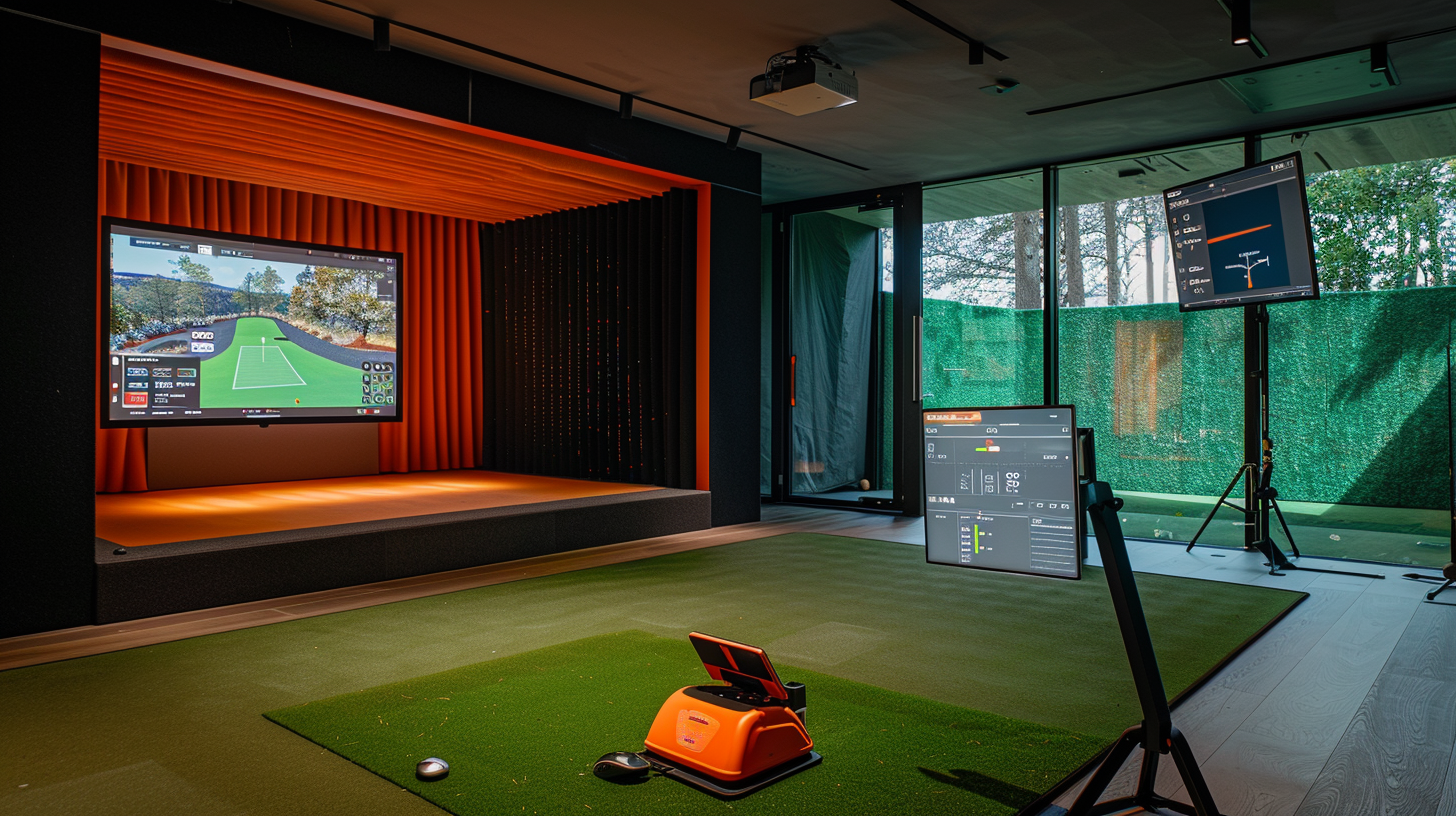
When planning a premium residential golf simulator or outfitting a high-performance commercial fitting bay, your primary investment choice dictates your entire environment. The head-to-head comparison of the Trackman 4 vs Foresight Sports QuadMAX represents the absolute pinnacle of ground-based tracking hardware. Both systems sit on the floor and capture elite, tour-validated datasets, yet they analyze golf ball and club telemetry through entirely different laws of physics.
Choosing between a dual-Doppler radar system and a quadrascopic photometric camera engine involves much more than a personal preference for hardware aesthetics. Your choice will permanently define your physical room dimensions, dictate your computer system components, and govern your long-term software operational costs. To prevent expensive integration errors, builders must look directly at the precise sensor layouts, internal processing pipelines, and spatial constraints of these two industry-leading units.
The Quick Answer / Key Takeaways
- Core Tracking Technology: Trackman 4 leverages Dual Doppler Radar technology fused with an internal optical camera system to map continuous ball flight. The Foresight QuadMAX utilizes a pure ground-based Quadrascopic (four-camera) photometric array that freezes the ball at impact.
- Spatial Depth Requirements: Trackman 4 requires a deep environmental footprint, demanding a minimum of 8 to 10 feet of space behind the ball and 10 to 12 feet of ball flight to the screen. The QuadMAX requires only enough physical clearance to safely execute a full driver swing, sitting just 14 to 18 inches away from the hitting zone.
- Tracking Substrates and Interference: Trackman 4 tracks objects using microwave radio frequency reflections, making it sensitive to indoor metallic objects and electrical interference. The QuadMAX uses an infrared flash array and optical lenses, rendering it completely immune to acoustic waves or metal piping.
- On-Board Diagnostics and Mobility: The QuadMAX acts as a completely autonomous tracking computer, featuring an onboard color touchscreen interface and internal memory. The Trackman 4 is heavily dependent on a continuous connection to a high-end computing terminal to review basic shot profiles.
- Club Metric Acquisition: The QuadMAX captures precise club deflection and real-time impact location by visually tracking a four-dot reflective sticker pattern on the clubface. Trackman 4 measures overall club head parameters using radar sweeps without face stickers, though it requires specialized reflective golf balls to capture accurate indoor spin rates.
Core Sensor Physics: Dual-Doppler Radar vs Quadrascopic Optics
To deploy either piece of hardware with absolute confidence, we must analyze the engineering mechanics that occur during the sub-millisecond event of a golf swing. How these launch monitors interact with data defines their real-world measurement reliability.
The Microwave Tracking Matrix of Trackman 4
The internal architecture of the Trackman 4 centers around a proprietary dual Doppler radar antenna matrix. One dedicated antenna array focuses its microwave beam exclusively on the short window of the club head entering the hitting area. This tracking sensor captures initial club path vectors, attack angles, and face orientation changes relative to the target plane.
The second radar antenna focuses down-range. It tracks the physical movement of the golf ball from the instant it leaves the clubface until it impacts the projection screen. By emitting a continuous electromagnetic wave at a specific frequency, the unit calculates speed and trajectory changes based on the subtle frequency shifts of the waves reflecting off the spinning ball.
[IMAGE PLACEHOLDER: Vector diagram showing the dual-radar tracking paths emitting from the rear of the hitting bay + Alt Text: Trackman 4 dual Doppler radar wave emission and flight tracking path diagram]
The High-Speed Photometric Array of the QuadMAX
The Foresight Sports QuadMAX relies entirely on a stereoscopic configuration of four ultra-high-speed optical sensors. These global shutter lenses are precisely aligned inside a rigid, lightweight magnesium alloy chassis. Rather than tracking the ball along its flight path over time, the QuadMAX captures high-contrast images of the ball cover at the exact millisecond of separation.
Supported by an integrated infrared light-emitting diode flash matrix, the QuadMAX takes multiple frames within the first few inches of ball movement. The internal processing chip uses these images to track the physical movement of the ball’s dimples. This allows the system to directly measure speed, launch angles, and true axial spin vectors without requiring down-range flight tracking.
Technical Specifications and Metric Frameworks
Reviewing the raw hardware engineering parameters reveals how each manufacturer approaches high-velocity data extraction. Both units deliver tour-validated precision but present their telemetry through different data pipelines.
+--------------------------+----------------------------+----------------------------+
| Structural Metric        | Trackman 4                 | Foresight QuadMAX          |
+--------------------------+----------------------------+----------------------------+
| Core Tracking Sensor     | Dual Doppler Radar + CMOS  | Quadrascopic Photometric   |
| Device Floor Position    | 8' to 10' Behind the Tee   | 14" to 18" Side of Mat     |
| On-Board Interface       | LED Status Strip Only      | High-Res Color Touchscreen |
| Weight Load Profile      | 6.2 lbs (2.8 kg)           | 6.3 lbs (2.86 kg)          |
| Power Subsystem          | Internal Lithium-Ion       | Swap-Capable 12000mAh pack |
| Spin Verification        | Requires RCT Marked Balls  | Direct Cover Dimple Read   |
| Structural Chassis       | Polycarbonate / Aluminum   | Ruggedized Magnesium Alloy |
+--------------------------+----------------------------+----------------------------+
Ball Delivery Telemetry Analysis
When evaluating the ball metrics of the Trackman 4 vs Foresight Sports QuadMAX, both devices provide comprehensive, professional-grade values for initial ball velocity, vertical launch angle, horizontal launch direction, backspin, sidespin, and overall spin axis tilt.
Because the QuadMAX views the ball surface from a close, fixed ground position, it captures raw pixel adjustments across the ball’s dimple profile. This enables the machine to read spin vectors directly from any standard premium golf ball without using unique surface markings.
Trackman 4 relies on tracking the movement of a radar reflection over a physical distance. In short-flight indoor simulator rooms, standard golf balls may not provide enough high-contrast radar reflection to capture exact spin numbers on high-velocity shots. To ensure perfect data capture indoors, users should use specialized Titleist Pro V1x RCT (Radar Capture Technology) golf balls. These balls feature an internal metallic lining designed specifically to maximize radar signal return to the antenna panel.
Club Delivery Data Integration
Capturing club head metrics during high-speed delivery reveals a major difference in workflow and data capturing methods between these two devices.
The Trackman 4 tracks overall club parameters without requiring face stickers. Its radar sensors calculate club head velocity, path, and face angle by tracking the bulk mass of the club head through space. This stickerless workflow is highly valued in busy commercial facilities and multi-player gaming rooms where players want to switch clubs instantly without pausing to apply markers.
The Foresight QuadMAX requires applying a specific four-dot reflective fiducial marker pattern directly onto the clubface to unlock its complete club telemetry suite. By tracking these high-contrast reflective dots, the quadrascopic system monitors exact face deformation, dynamic loft, impact lie angle, closure rate, and horizontal or vertical impact location down to a fraction of a millimeter.
[IMAGE PLACEHOLDER: Macro view of the customizable MyTiles layout on the QuadMAX screen + Alt Text: Foresight Sports QuadMAX touchscreen displaying customized club delivery tiles]
Spatial Envelope Boundaries and Room Geometry Layouts
Your physical room dimensions serve as the ultimate constraint when selecting your hardware architecture. Disregarding these technical requirements will lead to missed shots, tracking dropouts, or hazardous playing conditions.
The Deep Longitudinal Footprint of Trackman 4
Indoor radar installations require significant physical depth to operate reliably. The Trackman 4 must sit on its integrated tripod legs exactly 8 to 10 feet behind the designated tee position, aligned perfectly level with the turf plane. Additionally, the ball must travel through a flight corridor of at least 10 to 12 feet before hitting the screen.
This requires a total unobstructed room depth of 18 to 22 feet. If your space is shorter than 18 feet, the radar waves cannot gather enough data points to compute true spin dynamics before the ball hits the screen, causing the software to rely on estimated ball models.
[IMAGE PLACEHOLDER: Architectural floor plan highlighting the deep spatial requirements of a radar setup + Alt Text: Minimum room depth dimensions required for a proper Trackman 4 indoor installation]
The Compact Lateral Footprint of the QuadMAX
The QuadMAX completely removes the need for extended room depth. The unit sits flat on the floor 14 to 18 inches away from the ball, positioned to the side of the hitting mat. It maps all data within a localized 18-inch by 14-inch optical capture box.
Consequently, your room depth is limited only by your physical swing clearance and a safe bounce-back distance from your screen—typically requiring a total depth of just 14 to 15 feet. However, because the unit must face the hitting zone, you need adequate room width. If you regularly host both left and right-handed golfers, the unit must be manually shifted to the opposite side of the mat, requiring a symmetrical room width of at least 12 to 14 feet to clear wall spaces comfortably on both sides.
Computer Processing Specifications and Local IT Infrastructure
High-performance tracking units capture immense datasets that must be processed immediately by heavy-duty graphical workstations. Budgeting for an underpowered computer will cause noticeable shot delays, choppy frame rates, or frequent software crashes.
The Intel-Only System Constraints of Trackman
The Trackman Performance Studio software engine requires specific computing hardware architectures to function correctly. The tracking code is deeply optimized for Intel processing instructions. AMD processors are fundamentally unsupported and will cause fatal communication errors or missed shots.
For a standard indoor Trackman 4 configuration, your host PC must feature at least a 12th-generation Intel Core i7 or i9 processor. For graphics processing, an NVIDIA GeForce RTX 4070 Ti is the baseline requirement for standard HD rendering, while smooth 4K course rendering requires an RTX 4080 or RTX 4090. The computer must also feature 32GB of RAM and two separate, dedicated Gigabit Ethernet ports to maintain a direct wired data link to the radar unit while preserving your home network internet access.
Foresight Falcon and QuadMAX Workstation Allocation
Foresight’s FSX Play software suite is more flexible regarding your central processing unit brand, integrating comfortably with both Intel and AMD processors. However, because its rendering engine leverages advanced gaming architectures for lighting and turf texturing, GPU requirements remain high.
To play demanding simulation courses smoothly in 1080p, the PC must use at least an NVIDIA RTX 3070 or RTX 4070. For crisp 4K multi-projector outputs, an RTX 4080 paired with 32GB of high-speed DDR5 memory is required to eliminate frame stuttering during the critical transition from physical club impact to virtual ball flight tracking.
The Premium Upgrade: Bulletproofing the Hitting Studio
Integrating top-tier hardware like the Trackman 4 or QuadMAX into a high-end simulator bay requires upgrading every surrounding component. Utilizing low-tier accessories will skew your tracking data and risk structural property damage.
Premium Strike-Forgiving Stance Mats
Ground-based tracking systems monitor your club head as it enters the low point of the swing arc. Cheap, standard driving range mats feature dense nylon fibers glued directly over rigid foam backing. When a golf club head hits this unyielding surface, it bounces artificially off the floor.
[IMAGE PLACEHOLDER: Engineering cross-section of a high-impact multi-layer foam and turf hitting strip + Alt Text: Luxury multi-layer golf simulator hitting mat designed to minimize club head bounce]
This harsh deflection skews the angle of attack and dynamic loft metrics on both tracking devices, producing inaccurate numbers that do not match real outdoor turf behavior. To avoid this, outfit your simulator bay with a premium, strike-forgiving stance mat featuring an independent, modular hitting strip insert. Premium inserts allow the iron head to move down and through the ball naturally, ensuring your indoor swing analytics remain highly accurate while protecting your joints from repetitive impact stress.
Heavy-Duty Polyester Impact Screens
A golf ball launched at high velocity carries immense kinetic energy. To stop these balls safely and quietly, your enclosure must use an impact screen woven from premium, multi-layer polyester fibers designed for heavy impact and minimal image bleed.
The screen frame should be constructed from thick steel piping wrapped in high-density acoustic foam safety padding. The tensioning must be dialed in carefully using heavy-duty bungees or adjustable side-straps. If tensioned too tightly, the screen will act like a trampoline, rebounding golf balls back at the golfer or straight into your delicate floor-mounted electronics. If tensioned too loosely, the screen will sag and sway, distorting your projected image and causing tracking dropouts due to secondary movement.
High-Bandwidth Shielded Cabling
Both tracking units handle substantial data streams every second. Wireless drops or signal delays can result in missed shots or laggy rendering.
- For the Trackman 4: Ensure the unit connects to your computer via a shielded Cat6a Ethernet cable run through protective floor conduit. Avoid standard consumer Wi-Fi connections in areas with heavy wireless congestion.
- For the QuadMAX: When connecting to a PC for full-room simulation, use a high-bandwidth USB-C tether or a dedicated wired network link to ensure instant data transmission to the graphics engine.
Pro-Level Maintenance and Calibration Protocols
Ground launch monitors operate in harsh environments filled with airborne dust, synthetic turf fibers, and high-impact vibrations. To keep your data perfectly accurate over time, implement these preventative maintenance routines.
The Anti-Static Optical Preservation Hack
Indoor simulator bays generate immense static electricity as golf balls compress against impact screen fibers at high speeds. This invisible static charge acts like a magnet, pulling fine turf dust, carpet lint, and screen debris directly onto your launch monitor’s optical lenses.
Never clean the delicate camera lenses of your QuadMAX with an ordinary shirt, paper towel, or a standard industrial microfiber cloth. These materials trap micro-grit particles that can permanently scratch your lens’s specialized anti-static optical coatings, blurring the sensor’s vision over time. Instead, use a manual DSLR rubber air blower to clear away loose dust, then gently clean the glass surfaces using a specialized camera-grade optical wet wipe.
Dual-Radar Co-Axial Leveling Calibration
For radar installations like the Trackman 4, subtle target alignment errors are the primary cause of inaccurate indoor shape and spin axis readings.
- Never place the tripod legs on an uneven or soft turf surface that can shift during use.
- Secure a permanent, high-contrast alignment line directly onto your floor mat using a precision cross-line laser level.
- Align this line perfectly parallel to the center axis of your impact screen.
- At the start of every session, verify that the Trackman 4’s internal digital cameras are aligned precisely with your floor line. Taking a minute to confirm this physical alignment ensures your horizontal launch directions and side spin metrics remain flawlessly accurate to your target line.
Summary of Software Ecosystems and Operational Models
The long-term cost of ownership varies significantly between these two ecosystems. Choosing a hardware platform also commits you to its specific digital licensing model.
The Turnkey Foresight Licensing Suite
The Foresight QuadMAX follows a lifetime perpetual licensing structure. Your initial hardware investment includes complete, non-expiring access to:
- FSX Play (Hyper-realistic Unreal Engine simulation)
- FSX 2020 (Comprehensive baseline practice suite)
- FSX Pro Performance Analytics
- Full Awesome Golf Lifetime Membership
There are no mandatory annual subscription fees required to keep your device active or to review your core practice metrics. The system also integrates cleanly with third-party software engines like GSPro, allowing you to use community-built course libraries without ongoing hardware access paywalls.
The Tiered Trackman Subscription Platform
Trackman operates on an annual software subscription model to keep its platform active and updated. The base hardware package requires an ongoing software fee, typically ranging from $700 to $1,100 annually depending on your selected tier.
This subscription unlocks their proprietary Trackman Performance Studio (TPS) software and their Virtual Golf simulation engine, which features world-class, drone-mapped LiDAR recreations of famous tournament courses. The Trackman ecosystem is a strictly closed network; it does not natively support third-party software engines like GSPro or E6 Connect, requiring users to use Trackman’s built-in software suites for all simulation and practice activities.
Pre-Flight Installation Checklist
Before purchasing your hardware and starting construction on your hitting bay, ensure your room fully complies with these final technical requirements:
- [ ] Room Depth Checked: Minimum 15 feet of total depth for the Foresight QuadMAX; minimum 18 to 22 feet of total depth for the Trackman 4.
- [ ] Processor Architecture Verified: Computer build features a high-performance Intel CPU if installing a Trackman 4 system.
- [ ] Electrical Interference Cleared: No large metal appliances, exposed metallic piping, or unshielded fluorescent ballasts in the direct radar path of the Trackman 4.
- [ ] Turf Interaction Upgraded: Hitting mat utilizes a premium, strike-forgiving insert to prevent club head bounce from distorting attack angles.
- [ ] Optical Supplies Acquired: Dedicated DSLR rubber air blower and specialized anti-static lens wipes are available in the bay for regular maintenance.
Custom Setup Reference Guides
- [INTERNAL LINK: Deep Dive Troubleshooting for Indoor Radar Alignment Discrepancies]
- [EXTERNAL LINK: Official STG Engineering Standards for High-Velocity Indoor Impact Enclosures]